Showing posts with label Appalachia. Show all posts

Monday, May 25, 2026

Book Review: Magic from the Hilltops and Hollers

Leah Middleton, Magic from the Hilltops and Hollers. Newburyport, MA: Weiser Books, 2025. 9781578638802.

Genre: witchcraft, magic, folk
Subgenre: regional, memoir
Format: trade paperback
Source: Hutchins Library, Berea College 


I recently finished reading this book that takes you deep into Appalachian roots, magic, and folklore. The author, a practitioner of Appalachian folk magic and a traditional witch, takes us on a regional tour where we learn the lore and its magic. 

The book is arranged as follows: 

  • A foreword by Rebecca Beyer, author of the book Wild Witchcraft. (Worldcat link).  
  • A note to the reader. 
  • An introduction.
  • Seven chapters. Topics covered include an overview of the region and its history, witchery, folk healing, and a sampling of regional tales. 
  • Epilogue.
  • A list of references. You may want to consider some of the sources on this list for further reading. 

This may be one of the nicest books I've read this year. It is accessible and easy to read. It often feels like you are sitting in a rocking chair on a porch listening to an elder share their experiences, their magic, and the knowledge they wish to pass on. The author starts with a regional overview of the people and land. By now I've read a few books about Appalachia, and the regional overview for outsiders is pretty much a requirement. The author manages to make it an interesting read. After that she delves into various folk and magical topics. 

This is a book that draws you in, and you just keep on reading.  You can tell the author has a passion, a devotion, and respect for the region, the land, its people, and the practices. 

I'd say if you need an entry point into the region's folk witchery and magic, this book can provide a start. If you are just curious about the topic, want to read some stories, and learn more, this may be for you as well. If you are like and wish to learn more as a transplant, this book can be for you. 

Overall, I highly recommend this book, especially if you have local interest. I do recommend it for public and academic libraries. My library ordered it, mainly for the regional interest. For me, it was worth reading to learn about some traditions in a land I call home now.

5 out of 5 stars. 

Additional reading notes: 

The author tells us this is not an academic book. Rather it is. . . 

"This is more of a love letter to the mountain magic that survives here and an exploration of how it came to be, and how it can be applied today in a modern folk practice. Understanding the people's history is essential to understanding the foundations of any folk magical practice" (10). 

From her tone and how she writes you can just feel that love. And I've heard that elsewhere and learned it, how in order to understand a people's magic and/or understanding a people in general you need to study and understand their history. I suppose that is one thing I am doing in reading books like this: seeking to understand the people and their history. 


In mountain traditions, Christianity, in any number of forms, is not far behind, a lesson I've learned by now. The author now adds, or rather reminds us of animistic beliefs that weren't really left behind when Christianity came in, beliefs that the land is a living and breathing spirit. Practitioners, many of them, adapted accordingly: 

"The spiritual connection between the practitioner, the land, and their Lord established a dual religion-- a belief I like to refer to as mountain faith, where Christianity and animism meet" (67).


Purpose of the book: 

"The purpose of this book was not only to continue the conversation of these healing traditions, folkways, and magic, but also to provide a glimpse into Southern Appalachia's history by exploring the context of the ever-growing diverse culture. To dig into the depths of why and how" (213).  


Some books from the references list I would like to read, for the TBR list: 


This book qualifies for the following 2026 Reading Challenge: 


Friday, April 03, 2026

Book Review: Kentucky's Packhorse Librarians

Nicki Jacobsmeyer, Kentucky's Packhorse Librarians. Charleston, SC: Arcadia Publishing, 2025. ISBN: 9781467162180.  

Genre: photography, history
Subgenre: regional interest, Kentucky
Format: hardback
Source: Hutchins Library, Berea College 
 

This book is part of the "Images of America" series. These book are often photographic histories of towns, neighborhoods, cities, and regions. Odds are good if you've been to a small town's visitor center or a historical society, they probably have a local version in their gift shop. 

This particular volume focuses on the packhorse librarians of Kentucky. This was a New Deal WPA program that provided funding for librarians and volunteers to deliver books and reading materials to deep rural areas. They did so riding horses or mules as they often visited places that were challenging to access. During the Great Depression, these packhorse librarians bought solace, literacy, entertainment, comfort, and hope to some of the poorest areas in Kentucky and Appalachia.

The book features an introduction, seven chapters, and a small bibliography. The strength of the books is in the black and white photographs drawn from various archives. The photos show the work the librarians did, the people they served, and the region. You truly get a feel that you are stepping back in time. In addition, all photos include a text caption to describe the photo as well as tell the overall story. 

The book as a whole is relatively easy to read. It shows a bit of history not many outside the region may know. Book is very basic, almost like an annotated photo album. 

Recommended for libraries in Kentucky. Some library school programs looking at histories of libraries may want to consider it. For academic libraries, may want to consider it if their school teachers about the Great Depression. We ordered it here I am sure due to regional interest plus some of the photos come from our Special Collections and Archives department. In the end, I really liked it. 

4 out of 5 stars.

 Qualifies for 2026 Virtual Mount TBR Reading Challenge. 


Friday, March 27, 2026

Book Review: Mailman

Stephen Starring Grant, Mailman: my wild ride delivering the mail in Appalachia and finally finding home. New York: Simon and Schuster, 2025. 9781668018040.  

Genre: memoir, work, jobs 
Subgenre: Appalachia, USPS
Format: hardcover
Source: Hutchins Library, Berea College  
 

This is the author's memoir of his one-year stint working as a rural postal carrier in the Blue Ridge Mountains of Virginia. When he loses his fairly high end consulting job, he needs work that will provide some good health insurance. It turns out the U.S. Postal Service does that, and the health insurance kicks in right away once you are hired. Also, he loses his job just as the pandemic is starting to explode, he has health issues, cancer, and he is 50, so that adds to the urgency. 

The publisher describes the book as "exuberant, hilarious, and profound memoir." I would not go that far. I picked up this book for a couple of reasons. One, I thought the topic about a mailman and the USPS would be interesting. Two, the book is set in the Appalachian Region, so it has a regional interest locally. I had some high expectations, though I knew this book is another example of "someone does a stunt for a fixed amount of time then gets a book out of it" genre. I've read a few of those books. Some were good, and others not so much. This one for me falls into the not so much. 

An issue for me is that the book is not that interesting at times. The quality of interest can vary. There are some slow parts, some amusing parts, and some parts where he is just a dumbass. Some of the history of the postal service and the look at how the postal service works, especially in rural areas, are interesting. Some of the deliveries he made and the stories that go with them can be interesting and humorous as well. Yet there are some slow moments, some moments where he is wallowing in self pity, and one or two not so bright moments where you wonder how he stayed employed. So the narrative goes up and down a bit. 

For me also the book felt a bit predictable. Like we knew he was only doing this for a year, and you could kind of figure out he would go back to a more "normal" life by the end of the book. Spoiler alert: he does. He finds a new job in his field, and he leaves the postal service. Naturally, he ends up growing as a person with a better appreciation for the postal job as well as its service ethic and nobility. He ends with a bit of a promotion bit for people getting more involved in public service. In that regard, the book is not that much different than other "stunt" books where the protagonist decides, whether for fun, necessity, or other reason, to do the thing, and then writes a book about it to share their insights and growth. To be honest, fun as some of the stories were, the end just feels like another feel good story with a touch of treacle. 

Overall I liked it, but I found myself forcing my way to get to the end. It just did not keep my attention that much. However, the subject and setting have a strong regional appeal, so folks who enjoy reading about Appalachia and rural settings may enjoy this more than I did. Also if you want to learn a bit more about how the postal service works, especially the rural service that is so vital to those areas, yet few outside of those areas think about it, this may be a book for you too. I would still recommend it for all libraries, especially ones in the region. I am sure the regional interest is part of why our library ordered it. 

In the end, it was mostly OK. 

2 out of 5 stars.   


Books that may have similar appeal factors: 

A.J. Jacobs, The Year of Living Biblically (my review).  

Josh Peter, Fried Twinkies,  Buckle Bunnies, and Bull Riders: A Year Inside the Professional Bull Riders Tour (my review).

Andrew Beattie, Sleeping Around in America: Revisiting the Roadside Motel (review, which includes a list of additional similar appeal books).


Wednesday, March 11, 2026

Book Review: Queer Communion

Davis Shoulders, ed., Queer Communion: religion in Appalachia. Lexington, KY: University of Kentucky Press, 2025. ISBN: 9781985902961. 

Genre: memoir, Christianity, Appalachia
Subgenre: religion, regional interest
Format: trade paperback
Source: Hutchins Library, Berea College  


This book is a collection of 12 poems, essays, and stories by and about LGBTQ+ folks and their experiences with religion in Appalachia. Religion in this context is Christianity, and in Appalachia this mostly means very conservative, right wing Christianity. In other words, the kind of Christianity that, to put it charitably, is not very welcoming to queers and other LGBTQ+ folks. 

I found the book to be very moving. Personally it challenged me as I struggled a bit to understand why some choose to stay despite awful treatment. The answer to that can be complicated for the writers. For good or ill, their Christianity may be tied to racism and outright bigotry, but it is also tied to some good close family experiences, friendships, and/or positive spiritual moments. It may be hard to leave the religion of your kin, bigoted as they may be, when your granny happens to also be the one who helped raise you or just plain loved you despite the fact she may hate queers otherwise. I can see where the writers experience some tough choices and struggles with their consciences all while trying, often, to accept their queerness and decide whether to come out or not, to leave or stay home, so on. At times you feel the tension as you read the book. 

This is the kind of book I say more people should read, but sadly they won't. It is also a book that clings to some hope. 

I recommend the book for all libraries, especially libraries in the Appalachian region. Academic libraries need to have this, especially for academic programs in religion, women and gender studies, LGBTQ+ studies, and social justice. It may be an academic press book, but its accessibility makes it a good selection for public libraries too. 

I am glad I read it even if there are parts I disagree on or struggled with them, mainly about those who may remain to stay inside a religious tradition that hates them. Then again, I am a heathen, and it is their choice to make. 

Overall I'd consider this an essential book. Definitely a good one to include in various LGBTQ+ library displays. 

5 out of 5 stars. 


Additional reading notes: 

On loving people who hate them: 

"It occurred to me, gay Appalachian man that I am, that effectively all queer Appalachians and Southerners have loved people who hated them-- or at least parts of them, parts that can't be divided out. If we hadn't loved people who hated parts of us-- perhaps even most-- of us would never have learned to feel love at all" (x). 


On queerness as spiritual: 

"In a world of fascist ideologies, I have learned that queerness is spiritual in its own right. That simply coming into being and surviving in this world is an act of spiritually defiant, radical soul resilience" (21). 


On some Christians: 

"There are people who want to run us off the road, burn us, shoot us. There are others who don't want to hurt us but wish they could close their eyes and in a flash we'd cease to exist. Some of those people call themselves Christians" (86).

So very often it goes between Christians willing to get their hands dirty to hurt queers and those unwilling to act on their bigotry, unwilling to get their hands dirty, but very willing to support policies and provide silent tacit support to the active bigots.   


This book qualifies for the following 2026 Reading Challenge: 


Friday, October 24, 2025

Book Review: This Book is Yours and Free to Keep


Connie Banta, ed., et.al. This Book is Free and Yours to Keep: Notes from the Appalachian Prison Project. Morgantown, WV: West Virginia University Press, 2024. ISBN: 9781959000358. 


This book is a collection of letters and artwork by people imprisoned in West Virginia, Virginia, Tennessee, Kentucky, Ohio, and Maryland. These are the states served by the Appalachian Prison Book Project.  This book is the story of those APBP serves. Through their writings and art, the incarcerated highlight key issues such as racism, poverty, violence, and literacy. We also hear from them about the power of reading, books, and learning to change lives and bring hope. 

The book is arranged as follows: 

  • Preface.
  • Introduction. This provides some history of the APBP. It explains a bit about the letters and what kinds of issues and requests they feature. 
  • Editorial Statement. This discusses how the book was put together, how the letters were curated and selected, and how the book is organized overall. 
  • Chapter 1: Book requests. 
  • Chapter 2: Access and Restrictions.
  • Chapter 3: Letters as Windows.
  • Chapter 4: Circles, Classes, and Conversations. 
  • Chapter 5: Weaving Webs. 
  • Where is the Honey? A closing essay.
  • Afterword, Works Cited list, and a Resources list. The Works Cited includes books and a broad range of articles. The list of resources features groups and organizations by topic. 

Each chapter has a theme. Each chapter starts with a short preface, and then we get the letters and art from the incarcerated. A strength of the book is that it let's prisoners do most of the writing and speaking. We see and come to appreciate their experiences through their writings and art. 

These are often very moving and powerful letters. Some are long; some are short. Some have prose; some have verse. These documents also highlight a lot of creativity, imagination, feelings, thoughts, dreams, wishes, and other strong emotions. The editors keep their role to a minimum to let them speak their own words.  

The book overall is an easy read. It is also a powerful document of the human spirit. It is also an important book about the region and the impact of the prison industrial complex in the region. I recommend the book for public and academic libraries. For libraries with strong collection focus on Appalachia  this book is essential. We ordered it for our collection. Locally, this book may be of interest in General Studies, Peace and Social Justice, Sociology, and Education. It may also be of interest for LIS programs. 

In the end, this is an excellent book I recommend for all readers. 

5 out of 5 stars. 


Additional reading notes: 

 The range of book requests: 

"The requests cover the spectrum: sci-fi, westerns, poetry, manga, astronomy, LGBTQ+ literature, books by Black writers, books on how to draw or learn music  or start a business, books on indigenous histories, dictionaries, books in Spanish, puzzle books. One person only wanted books on West Virginia. Another wrote, 'I'll read anything you send to me'" (1). 


A note on their archive: 

"We have accumulated an archive of tens of thousands of letters that document reading practices and everyday life in prisons and jails in the early twenty-first century. These materials are a testament to the ways people held captive in our region continue to learn, to grow, and to support one another and their loved ones" (1).


APBP's dream: 

"Our dream is not more books in confinement but an end to torture, not more programs in prisons and jails but an end to mass incarceration and perpetual punishment" (7). 


According to Emma Kelly, as cited in the book, 3 reasons that encourage prison building in Appalachia: 

  • Decline of coal and the economic hole it left. 
  • Plenty of Open Spaces, leftover from industries like mining that have left the region.
  • Cultural marginalization of Appalachia (74).


Items from the Works Cited I may want to read: 


This book qualifies for the following 2025 Reading Challenge: 


Friday, August 15, 2025

Book Review: Appalachian Folklore Unveiled

Darkness Prevails and Carman Carrion, Appalachian Folklore Unveiled: mysterious happenings of folk spirits and mystic shades from the ancient foothills. New York: Wellfleet Press, 2024.  ISBN: 978-1-57715-440-2. 

Genre: Appalachian region
Subgenre: Folklore
Format: hardcover
Source: Hutchins Library, Berea College 
 

This book collects a variety of tales, stories, beliefs, superstitions, and omens from the Appalachian region. We get to learn a bit about the region's  history and its people through these tales and have been handed down from one generation through the next. 

The book is arranged as follows: 

  • An introduction that describes the book's organization and content. 
  • History, Culture, Legends, and Influences. 
  • Superstitions, Omens, and Spooky Traditions. 
  • Apparitions and Haints. 
  • Cryptid and Hybrids. 
  • Monsters and Demons. 
  • Conclusion. In addition the authors also offer a list of resources if you want to learn more. 

Naturally the first part covers history and culture. This is where you get the primer about the region so common in books like this. This is more information for outsiders who may know little to nothing about Appalachia. If you are a local, you can probably skim or skip that part. If you are an outsider, you should read it.  Though I am a transplant, I've lived in the region enough and traveled in it to know the basics. I read it anyhow. 

Once you get past the basics, you get into the stories, which are the core of the book. The authors tell the stories, but they also offer a bit of history and context for the stories. Come of the stories and entertainment, stay for the learning and lessons. Stories overall are short, so they are easy to read. In addition, the book is in sections, so you can skip around and read what interests you first. Still, it is also a good book to read cover to cover. The book also features some sketch illustrations throughout. 

I really liked the book, and I found it very interesting. The book conveys the diverse traditions and superstitions that whites, Blacks, and Native Americans gave the area. 

I recommend the book for public and academic libraries, especially those in the region or that collect materials about the region. Folks interested in folklore and superstitions may find it of interest as well. It's a solid reference work on the topic that is accessible and interesting. 

4 out of 5 stars. 

Qualifies for the following 2025 Reading Challenge: 


Friday, June 27, 2025

Book Review: Appalachian Mountain Christianity

Bill Leonard, Appalachian Mountain Christianity: the spirituality of otherness. Athens, GA: The University of Georgia Press, 2024. ISBN: 9780820367248.

Genre: religion
Subgenre: Christianity, Appalachia, lectures
Format: hardcover
Source: Hutchins Library, Berea College


This small book looks at Protestant Christian traditions in the Appalachian Region of the United States. The main focus is on Baptists and Holy Pentecostals, including Primitive and Old Regular Baptists. The book also looks at snake handling churches in the region. 

The book is a text version of a series of lectures on the topic that the author delivered at Stetson University in 2023. The book features four lectures, presented as chapters in the book. The book is arranged as follows: 

  • Foreword by Mitchell G. Reddish. He introduces the main speaker (the book's author). 
  • Preface.
  • Chapter 1. Looking for Christians in Appalachia.
  • Chapter 2: "A Hart Chearing and Affecting Surmond." 
  • Chapter 3: Revisiting the "Woman's Sphere." 
  • Chapter 4: Otherness on the Margins. 
  • Notes. 
  • Index. 

 At 96 pages, this slim volume covers a lot of terrain. The first lecture gives us an overview of the topic. We get a bit of history with a look at modern times and how modernity has affected these often small churches. Next, we get a look at their preachers and their preaching craft. It discusses some of the techniques they use to deliver sermons and move their members. This is followed by a discussion of the role of women. Women get some leeway on certain issues, but they are also severely limited.  Let's be honest; there is a strong element of misogyny, and women do need to toe the line, stay in their "sphere," or risk shunning and/or expulsion. Finally we look at Pentecostal serpent handlers and the "no hellers" Primitive Baptists. 

I read this book for a few reasons. One, it has local interest. Our campus is part of Appalachia. We are at the border but still in the region. Many of our students come from places described in the book. As much as I can, I tried to read books about Appalachia just to learn more. Two, as a happy heathen, I am still curious about religious practices and beliefs of others, so I read it to learn more about the beliefs the book presents. Three, every so often we get students writing about and researching religion in the region. I read this book ot see if it is one I can suggest to those students, and I can say I would suggest it. 

For me reading it, the book was interesting, but it was not always an easy read. These churches have some beliefs I am not down with, to put it charitably. So be warned if you are not a Christian when reading this. That aside, the author treats the topic as an academic with a bit of detachment and plenty of citations and references. Even the work of local scholar Loyal Jones is cited often. Now this is an academic text, but it is a very easy and accessible read. I found myself reading through it at a good pace.  Part of the reason I am sure is these are lectures, so the author had to keep the work accessible to a listening audience. Unlike writing articles, where academics can get seriously verbose, ou need to be clear and accessible in your material for a public lecture. 

In the end, this was a pretty good read. Despite a few not so comfortable moments, I am glad I read this as I feel I learned a few things. Author has a way of humanizing these believers, and we do get a bit of a sad note as we see their way of life may be leading to extinction as they can't keep the pace of modern progress away away nor hidden from their communities. In a way, their days of being frozen in time are numbered. Personally, I would not shed a tear, but others may. 

If you want to learn more on this topic, this is a good selection. Locally, this may be of interest for some General Studies and Religion classes. I do recommend it. 

4 out of 5 stars. 


Friday, July 26, 2024

Book Review: Atheist in Appalachia

R.K. Brislin, Atheist in Appalachia: Nonbelief in Rural America. Astute Coyote LLC (independently published), 2023. ISBN: 9798385959662.

Genre: atheism, Appalachia
Subgenre: personal essay, memoir 
Format: paperback
Source: Hutchins Library, Berea College


The author is an atheist in a part of the United States where "belief in god is practically mandatory." The book is basically a collection of short essays where the author explores his experience as an atheist in an extremely religious region and lays out the arguments for atheism. 

The book is organized into 8 chapters. At 74 pages, this is a relatively short treatise to read. The specific focus on Appalachia is not something we see often when it comes to atheism. For some readers, there may be lessons and encouragement if they are doubters and/or atheists stuck in a rural area where you are judged by which Christian church you attend. 

However, the book suffers from that same sense of superiority that atheists tend to display. They've embraced science, reason, logic, and the religious are basically retrogrades that still believe in fairy tales. The author here may be a bit more polite about. If you've read other writings by prominent atheists, you've already read the basic arguments presented here. In some cases, such arguments do get aggressive. This author is no exception. His chapter on being vegan really hits readers over the head with the evils of eating meat. Therein lies a key issue with the book and atheists in general. They can be just as militant, aggressive, preachy, and judgemental as any Christian preacher. 

In the end the book for me was just OK, but I can see where it may give comfort to folks who doubt seeking some affirmation and encouragement to leave the old religion. Libraries in the region and in rural areas may want to add the book to their collections, in part just to add a different point of view. 

2 out of 5 stars. 


Qualifies for the following 2024 Reading Challenge: 


Friday, December 29, 2023

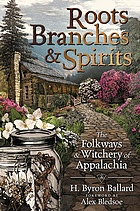
Book Review: Roots, Branches, and Spirits

H. Byron Ballard, Roots, Branches, and Spirits: the Folkways and Witchery of Appalachia. Woodbury, MN: Llewellyn, 2021. ISBN: 9780738764535.

Genre: memoir, Appalachia, folklore
Subgenre: magic, pagan, witchcraft, tales, spirituality, regional interest
Format: trade paperback
Source: Hutchins Library, Berea College


This book looks at Appalachian folk magic and witchery from a more southern perspective. The author is from North Carolina. As she writes: 

"My scope is the southern highlands, which is the section that includes western North Carolina, eastern Tennessee, southwest Virginia, northern Georgia and Alabama, and parts of Kentucky, Ohio, and West Virginia" (2). 


The author writes and teaches readers about the old ways. The publisher describes the book as "part cultural journey and part magical guide" (from the back cover). 

The book is arranged into two parts with nine chapters. Part One includes chapters 1-3, which cover most of the cultural journey element. Part One provides an overview of the region, its culture, and people. Much of this material would be for outsiders needing and wanting to learn about the region. Part Two covers the magical guide part of the book; it includes chapters 4-9. The book also features a conclusion, a list of recommended sources, which include organizations and websites, and a small bibliography. There is some overlap between the two lists. 

I found the first part of the book pretty interesting as a regional overview. However, if you have read similar books, some of this is familiar territory. Part Two looks at topics such as tools and supplies, kitchen witchery, healing, and haint tales. The second part is one you can browse if you wish and find the topics that interest you. Some topics are more interesting than others. Unlike similar books, the magic section can be light on details, a bit superficial even. I did enjoy the last chapter of tales. To be honest, one or two of those stories could be material for some supernatural anthology series. 

Overall, I liked the book, but it is one more to borrow. It can be a good acquisition for libraries, especially for libraries that collect Appalachian materials. 

3 out of 5 stars. 

Additional reading notes: 

Definition of cultural strip-mining, term coined by Marilyn McMinn-McCredie, storyteller: 

"Cultural strip-mining is the act of extracting folkways from a culture while returning little or nothing to it. People from outside the culture suck up what they find appealing or can monetize and let the rest fall away or die beneath the wheels of progress. The culture gains little from the exchange and gives up precious materials that leave it weakened in some ineffable way" (13). 


On oral traditions: 

"Oral traditions depend on several things. They must be shared. They must be heard. And they must be remembered. All of which run in a cycle throughout generations. When the line is broken-- for whatever reason-- that piece of the puzzle, that strand in the weaving, is lost for all time" (21). 


Friday, October 20, 2023

Book Review: Doctoring the Devil

Jake Richards, Doctoring the Devil: Notebooks of an Appalachian Conjure Man. Newburyport, MA: Weiser Books, 2021.  ISBN: 9781578637331.


Genre: Appalachia, mountain magic
Subgenre: folklore, regional interest
Format: trade paperback
Source: Hutchins Library, Berea College (yes, my library has it)


This is the author's second book, a follow up to Backwoods Witchcraft (link to my review).  In this book, the author introduces readers to some of the old conjurers and witches of Appalachia. He also discusses and presents ways for "doctoring the devil," which refers to "rooting out any unfriendly spirit bringing bad luck, poor health, and calamities of all sorts." In addition, the author offers his own tried and true spells and recipes to conjure love, money, justice, and success. The book covers a lot of ground, yet it is interesting and informative. 

The book is arranged into 13 chapters plus an introduction, a conclusion, two appendices, and a bibliography. Appendix A covers Zodiac signs and their corresponding body parts. Appendix B features a list of herbs and curios and their uses. 

After the introduction, the book starts with some background about the region and its people. If you've read the previous book, some of this may be familiar, but most of the initial material here is new. The author defines the types of workers found in the region and provides examples. Then through stories and examples, he gradually presents other topics such as catching spirits, conjurers, rituals, roots, and more. There are many lessons in the book, but it definitely does not read like a textbook or a how to manual. The author's strength is in the writing. He combines stories and a casual conversational style with the recipes and methods. This is as close as you can get to sitting in his porch and listen to him as he teaches us and shares his wisdom and craft. 

As I noted on reading similar books, keep in mind the Bible is very prominent in mountain magic and work. This work does not go far from Christianity and its influence. 

As with the author's previous book, you do not have to be a worker to read this. If you are seeking to learn how to do it, it is a good guide. This book does emphasize more how to do things. It may be more practical than the previous book. However, it also works as a good look at the region and a very significant part of its folklore. 

Overall, this is a very good book. If you are interested in the folklore and the magical traditions, this is a good book to read. If you are thinking you may be called to do this kind of work and want instruction on how to get going, it is a good guide as well. Workers and conjurers may want to add it to their shelf. For me, this was an accessible read by an author who is a great storyteller as well as generous teacher. The book is well written and draws you in with warmth and hospitality. 

For libraries that collect books on Appalachia this book is essential. 

It is an excellent read overall, so I am willing to give it the full 5 out of 5 stars. I'd add it to my shelf. 


Additional reading notes:

On the term "doctoring the devil": 

"While many know this as conjure or root work, those raised in the work and in the known called it 'doctoring the devil,' whether you're doctoring a root for someone or doctoring them of a root they're currently under. This title acknowledges how find the line is between God and the Devil. It's easy to sway with the power" (8-9).


Some old time books and guidebooks a witchdoctor and/or conjurer might have kept, especially in the early 20th century: 


What is a sin to a conjurer: 

"That is sin to a conjurer: wishing for a better life but not putting in effective steps to better it" (82). 


The role of faith if you undertake the works: 

"Faith and doubt cannot live in the same house, nor can fear be allowed to stand outside the door. If you plan to do this work, you must do it with every bone in your body and have nothing but trust in God and the spirits. You must have a strong will: you'll be conjuring angels and battling Devils to a fuller degree than most have witnessed. This is a way of life, and while it isn't for everyone, it is a calling that is a reward in its own. There is of course no need to be a professional at this: most folks work and use some things here and there to simply better the deck that life deals them, and that is fine" (218-219).


Friday, June 09, 2023

Book Review: Earthworm Gods

Brian Keene, Earthworm Gods (Preferred Author's Edition). Portland, OR: Eraserhead Press, 2014. ISBN: 9781621050599.


Genre: horror
Subgenre: post-apocalyptic, United States, Appalachia
Format: trade paperback
Source: Berea branch, Madison County (KY) Public Library


This book has two stories. We start with Teddy Garrett, an old man in rural West Virginia. As the novel opens, he tells us it's been raining nonstop for days with no sign of stopping. The town nearby is fully flooded, and the water is still rising. It has been 40 days of rain, but that may be the least of his worries. Giant worm creatures are rising from the ground as it rains. The second story comes from survivors of a helicopter crash near Teddy's location. Those survivors tell the story of the rain and monsters in Baltimore including satanists in the city making sacrifices to some creature. 

I thought this post-apocalyptic tale would be a better read. The author is very good at characterization. Teddy and his buddy Carl are very well drawn. These are people that readers can visualize and maybe even recognize from real life. However, the narrative is seriously slow and just dull, especially prior to the helicopter crash. Those first chapters just dragged. It was basically slow reading for me. 

Note that this particular edition is the "author's preferred edition." This edition includes an afterword from the author where he discusses how the novel came about and the inspiration for the characters. If you like reading authors discussing their craft, the afterword is worth reading. 

Overall, for me this does not feel like the author's best work. Pacing and narrative were fairly slow, not that engaging. I did enjoy his novel Castaways better (link to that review). I don't recommend Earthworm Gods, but I am still willing to try out other books by this author. 

1 out of 5 stars. 

Additional note.

This book has ads in the back for other books from the publisher. I am jotting down some titles that sound interesting to find later:


Friday, April 28, 2023

Book Review: Backwoods Witchcraft

Jake Richards, Backwoods Witchcraft: Conjure and Folk Magic from Appalachia. Newburyport, MA: Red Wheel/Weiser Books, 2019. ISBN: 9781578636532.
 
Genre: witchcraft, magic, folk magic, Appalachia
Subgenre: regional interest, folklore
Format: trade paperback
Source: Hutchins Library, Berea College


This book looks at Appalachian witchcraft through the eyes and experience of Jake Richards. Richards offers family stories, lore, and rituals and conjure crafts. The book provides just enough instruction for those who may want to embark on this path. 

The book is arranged into 11 chapters. Some of the topics covered include stories and superstitions, ancestor veneration, spelling and fortune telling, and folk recipes and remedies. Richards takes readers from the basics of land and culture of Appalachia to how to make an altar and do your conjure work. If you want to keep learning, the book includes a bibliography for further reading. 

A strength of the book is the author's welcoming and knowledgeable style. Whether you have lived in the region all your life, or your are a transplant to the region, Richards makes you feel welcome and that with devotion, work, and respect you can start learning and building a folk magic practice of your own. 

However,  you don't have to be a conjurer, folk magician, or an apprentice to enjoy and appreciate this book. If you just want to learn about Appalachia through its folklore and conjure magic, this is a good book. Richards is also a good story teller. I was often fascinated by some of the stories and superstitions the book presents. This is a part of Appalachia that few locals talk about, and Richards is generous enough to share these stories and traditions with readers. 

Like many books that cover various topics, some topics in this book are more interesting than others. All in all, the book is accessible and interesting for the most part. 

Overall, I liked this versatile book. Whether you want to learn how to become a conjure practitioner or just want to learn about local traditions and superstitions, this book is a good selection. I definitely recommend it for any libraries interested in the Appalachian region. My library already has it. 

4 out of 5 stars. 

* * * * * 

Additional reading notes: 


The craft has many names: 

"You may have heard this craft called granny magic, hill folk hoodoo, or mountain conjure, but it's all the same" (xiv). 


A reason for this book is to preserve this long time knowledge: 

"Most of the knowledge of these hills has been lost to the oppressions of  time and poverty. Before, this knowledge was known only by memory, and now the elders are quickly passing or forget. My mother's  mother has forgotten due to Alzheimer's, but she still sees. Young folks are walking around not knowing they have some of these gifts. We need a new generation to keep these roots alive. I am of that generation, and I hope you will be too. This magic is more than a tale of the hills and the whispers of the autumn fog; it's the history of my blood and bones, and possibly yours" (xv). 


What the author will teach here, well, part of it: 

"Instead, I'll teach you the charms and roots of my family, in exchange for your promise to uphold this tradition and preserve it as it is and was and will be. I am the only yarb doctor on both sides of my family now who actively does this work. Help me bear the candle, light your flame from mine, and let's continue this for a thousand more generations to come" (xviii). 


As in other hoodoo and similar practices, the Bible is very present in Appalachian mountain magic: 

"Regardless of your own preferences or beliefs, the Bible plays a major role in Appalachian folk magic, as it is set into the religious traditions of the Southern Baptists and Protestants. The Bible is often used as a 'spell-book' of sorts, but those who grew up in a close-knit Baptist household in Appalachia understand that the Bible means more than just the Word of God" (xix). 


How Appalachian folk magic came about: 

"Appalachian folk magic came about because it gave these people a sense that things were going to be alright even in the poor circumstances most found themselves in. It let them get a handle on things, one way or another. And it works. While you won't get rich quick, you can use it to better the circumstances the world sets against you, even if you are still piss-poor afterward. With it, you can foresee the cards you're about to be dealt and change the tables somewhat in your favor" (9). 


No need to get fancy with tools, use what you have: 

"The tools used in this work are common, so no need to worry about buying expensive things. And should you be without a certain tool, make use of something you already have. There ain't no sense in buying something I recommend when you may have something better. The old folks didn't have botanicas nor new age stores they could just hop on down for supplies, and I reckon they wouldn't step foot in one anyway. Instead, they used what they had, and if all they had was scraps of newspaper, yarn, and a candle then so be it" (139). 


Wednesday, July 17, 2019

Booknote: Appalachian Health and Well-Being

Robert L. Ludke and Phillip J. Obermiller, eds. with Foreword by Richard A. Couto, Appalachia Health and Well-Being. Lexington, KY: University Press of Kentucky, 2012.  ISBN: 978-0-8131-35861.

Genre: nonfiction, reference work
Subgenre: Appalachia, health, health care, academic essays anthology
Format: Hardcover
Source: Hutchins Library, Reference Collection

This note is a reference book review. We currently have this book in our collection at Hutchins Library; I saw it on our new reference books' shelf, and I decided to make this note both to help me better know this resource and to see if it can be helpful for our students here. In this note, I will mainly look at key features of the book, how it is organized, and why it may be useful and how. On a small side note, I will probably pull some notes or items from this review to write a small quick review for our library's blog about this book. What I am saying is this note is a bit different than my usual booknotes.

In our library, we get a lot of questions related to Appalachia and the region in general. Appalachia is also a big part of the college's curriculum, especially in the required reading second semester General Studies course, so we are always looking for resources in this area. Health in the region is often a popular topic in those classes, so this book seems relevant.

I need to note it was published in 2012. For some of our classes that may require sources within 5 years (for reasons I will not go into here), this book may already be "too old." However, for classes looking at the region more broadly and at overall conditions in the region, this book can be useful.

The book is a collection of scholarly signed essays on various health related topics in the region. The book is organized as follows:

  • List of illustrations
  • Foreword
  • Introduction
  • Three major parts, each containing a series of essays. The book has a total of 16 essays. The major part topics are: 
    • Appalachian Health Determinants
    • Appalachian Health Status
    • Urban Appalachian Health
  • Acknowledgements
  • Selected bibliography
  • List of contributors
  • Index

In his foreword to the book, Professor Couto tells us chapters in this book "addressed all the factors that promote health and well-being, including economic, political, psychological, environmental, and social ones" (xi). Maybe "all" is a bit too ambitious, but a look at the book's contents shows work "to put health and health care in a socioeconomic and political context" (xi). For many classes here on campus, specially in that General Studies curriculum I mentioned, this book can provide a good start for student research assignments.

This book is not just a collection of essays. The book's foreword and introduction provide a good overview of the complex issues of the region in terms of health and health care. The editor writes,

"This volume takes a broad perspective by focusing on the health of all Appalachians, both residents of Appalachia and those who have migrated from the region" (1).

The introduction's overview goes over various essential topics in a brief but clear manner in order to provide background material. Some of these topics include:

  • Medical services for rural areas
  • Health innovations
  • Definitions and concepts

What the book does not cover and why. This is the kind of statement that students and researchers need to pay attention to when considering a source for a research task or assignment as it presents the limitations of the work being considered:

"There are important Appalachian subpopulations (e.g African Americans, Hispanics, Eastern Band Cherokee) and health cohorts (e.g. those with HIV/AIDS) that are not discussed in this volume. Although women's health is reasonably well represented here, many other subgroups in Appalachia are not. This is not an intentional omission; it is caused by an unfortunate lack of reliable regional data on these populations" (16). 

The book's introduction includes a section on "organization of this book." Good scholarly essay collections often include this kind of section. Here the editors define how a book is organized and why they chose their book's arrangement as well as briefly describes each essay in the book. So for students, read the introduction, specially this part, to quickly assess how well this book may suit your assignment or not. For many topics on Appalachian health and health care, you may find this book is a good source. At the end of the introduction you will find endnotes and references used in the introduction, which can be useful for expanding your research.

In the book, each scholarly essay has its own list of references as well. Again, those references are a tool to help students and researchers expand their research. We librarians often call using references from a source "citation mining." Want to learn more about this research technique? You can ask your local friendly librarian.

Finally, the book has an index of terms you can use to locate specific contents in the book. Book also contains various tables, charts, and graphs.

I'd say for some of our classes here, especially for some in the General Studies curriculum as well as classes here and in other places in Appalachian Studies, health, and wellness, this book can be a good resource.

Note: no stars rating. This is a reference book. If you have questions about why I did not rate this book, see my book review statement.

Wednesday, March 20, 2019

Reading about the reading life: March 20, 2019 edition

Welcome to another edition of "Reading about the reading life" here at The Itinerant Librarian. This is where I collect stories about reading and the reading life. Basically, these are items related to reading, maybe writing and literacy, that I find interesting and think my four readers might find interesting as well with a little commentary. As with other features I do on this blog, I do it when I have time or feel like it. Comments are always welcome (within reason). 


Let's see what interesting things I have found for this week:

  • In Niger, a story about a derelict mosque being converted to a library and community center. Yes, they also built a new mosque nearby. Via De Zeen.
  • For your amusement and entertainment, a look at the art of book covers from 1820 to 1914. Via Public Domain Review
  • Maggie Levantovskaya tells us about being a college professor without books. Via Lit Hub.
  • Also via Lit Hub, something closer to home: a look at a radical bookstore in Appalachia. The story is Firestorm Books and Coffee. I am thinking road trip.  So what's the big deal? According to the article, "Since 2008, Firestorm has supported grassroots movements in southern Appalachia while developing a workplace on the basis of cooperation, empowerment and equity."
  • One  more via Lit Hub, a suggestion that every book tour include a public school
  • If you are wondering why so many children's books do not seem original, this may be why. According to a new report one in four children's books in 2018 were based on licensed properties. Via NPD Group. 
  • Another look at the publishing business. From Ethan Hirsch's blog, argument that we can look at publishing as venture capital. He writes, "While cynics or the uninitiated might be prone to roll their eyes at this attempt to draw a connection between the high-flying and innovative world of venture capital investing and the seemingly staid, stagnant, and predominantly print-based publishing industry, the comparison is a lot less farfetched than you’d think."
  • Do you feel like you are not reading enough books in a year? GQ has some suggestions on how to read 80 books a  year give or take. We also get some good advice on what to read and what to not read because not everything you read is good for you. Granted, you can read some fluff once in a while; I  certainly do, but it is also good to read some substantial books. 
  • Houstonia Magazine presents a profile of the downtown Houston Metropolitan Research Center and its rare books collection. The center is part of the Houston Public Library system. When I worked in Houston, my job was not far from this place.
  • On another bit of trivia: no, academic libraries do not buy as many books from Amazon as you might think. Via Forbes. I'd take that with a bit of a grain of salt. Most big academic libraries often have a "jobber"  like Baker and Taylor to purchase books from. For smaller places, like my workplace, a jobber may not be the best option. I will note we do get a few books from Amazon, and yes, often they are used books since budgets are tight. 
  • Brian Keene on his blog announces the 2018 nominees for the Splatterpunk Awards. These awards "recognize superior achievement in the sub-genres of Splatterpunk and Extreme Horror." This is a genre I've been wanting to read and explore more. 
  • Need to relax a bit? You like coloring books? Well, if you want something a bit different, you can download some free coloring books and images from various museums. Via Open Culture
  • Via  The Paris  Review, a look at reading in an age of distraction. Article also looks at the book The Gutenberg Elegies, which turns 25 years this year. 
  • Also via The Paris Review, an "ode to the library museum." 
  • Via The American Conservative, which I admit I do not read often but peek at now and then, a look at "the Hedonism of Reading Good Books." The article looks at William Hazlitt and reading "old"/classic books.  
  • Need some more reading ideas? Are you a revolutionary needing inspiration? Well, via The Paris Review, learn about what  Che Guevara and Fidel Castro read. A bit from the article: “'There are periods of boredom in the life of the guerrilla fighter,' he warns future revolutionaries in his classic handbook, Guerrilla Warfare. The best way to combat the dangers of ennui, he helpfully suggests, is reading. Many of the rebels were college educated—Che was a doctor, Fidel a lawyer, others fine art majors—and visitors to the rebels’ jungle camps were often struck by their literary leanings. Even the most macho fighters, it seems, would be seen hunched over books." 
  • Via The Times Literary Supplement, a look at the Bodleian Library's holdings of "obscene material."  Turns out that "established in 1882, it was dubbed the “Φ” (Phi) collection: this was the shelf mark used by the Bodleian to identify those texts deemed too obscene, libellous or otherwise risqué to be made available to undergraduate readers." This collection includes literary, medical, and erotica materials. Much of it is being displayed now. 
  • In a little trivia, it seems that letter writing is making a comeback, especially among younger people. There is a growth in pen pal clubs. Via Yes! Magazine.
On a side note, a look at the not so nice side of the reading life:


Friday, November 30, 2018

Book Review: White Trash

Nancy Isenberg, White Trash: the 400-year untold history of class in America. New York: Penguin, 2017.  ISBN: 9780143129677.

Genre: nonfiction
Subgenre: history, ethnicity, politics
Format: trade paperback
Source: Copy provided by the college as part of Dean's Reading Group

I read this sometime in 2017; it was before I declared my personal moratorium on reading anything political, activist, social justice, etc. Part of the reason I read it was for the campus Dean's Reading Group. I am including the basic notes I took when the reading group met at the end of this review.

If I have to describe this book in a nutshell, it would be this: the nation that became the United States has an atrocious history of basically exploiting anyone weaker and/or different for profit and gain. The irony is that very often, the racism and exploitation take turns. White people in the U.S. came from a variety of places, and many were not always seen as "white." The definition of "white" has also changed over time as one immigrant group who was previously seen as not white would settle in, integrate, become white, then act like racist assholes to the next group of immigrants. Rinse and repeat. The other big issue of course is wealth. Those who have it are more than happy to exploit those who do not. The term "white trash" mainly comes from poor whites who were literally dumped by the British in American shores to get rid of them in the old nation and put them to work exploiting the new lands. It is a term that has evolved and stayed. The book presents more details, but that is basically it in a nutshell. The exploitation and bigotry chain has not changed much from the early times of the colonies to the nation the United States is today. Kind of depressing when you really think about it.

It is not an easy book to read. For one, it is a heavy book in terms of theory and detail. In fact, much of the earlier part of the book dealing with the early history is fairly dry and repetitive, and I was tempted to drop the book a couple of times because it did have some seriously boring parts. However, once you get past that, it starts getting a little interesting. Isenberg in addition can be a bit preachy, which I bet was an extra reason the Dean's Reading Group found it appealing; they tend to like books that preach to the choir. The thing is this is a book that more people not in the choir need to be reading.

Overall, I liked the book despite it being a depressing read at times. As I said, I think more people need to be reading it. It did give me a lot to think about, and I made note of various passages to ponder and remember. Furthermore, the author provides extensive chapter notes documenting everything, and this provides material for readers wanting to learn more. Having said all that, this is the book that finally burned me out and made me declare my politics, social justice, activist materials moratorium. So take it for what its worth. The paperback edition I read does add a new preface to the book reflecting the 2016 elections and their aftermath.

3 out of 5.

* * * * * 
Additional reading notes:

Why you really need to pay attention to history. Donald Trump was not a trailblazer nor an innovator nor anything new in politics. If anything, he is just tired old recycled material from previous people, even down to his MAGA slogan:

"American democracy's quirky past haunted the Trump campaign. He was not the first cranky businessman to run for high office, even in recent memory. Ross Perot was, capturing 19 percent of the popular vote in 1992. Nor was Trump the first millionaire mogul with Hollywood ties to seek the presidency. That was William Randolph Hearst, a century ago. And he certainly can't claim to the first outsider who promised to clean up Washington and embody the hopes and dreams (and fears) of the common man. That honor belongs to Andrew Jackson. As critically, he was not the first politician to question the pedigree of a sitting president either. James Vardaman did that in spades, when he insulted President Theodore Roosevelt. Trump's rhetorical appeal to the "silent majority" was stolen from Richard Nixon. Sarah Palin paved the way for him as an earlier version of a Republican reality TV populist. Trump's favorite slogan, 'Make America Great Again,' was of course, Ronald Reagan's first" (xv). 

The argument of this book:

"The argument of this book is that America's class history is a more complicated story than we've previously considered. The past informs the present. Presidential candidates are not masters of their own destiny; rather, they are often a patchwork of rhetorical scripts, familiar gestures, political styles inherited from their predecessors, and whatever else they happen to borrow from the grab bag of popular culture" (xv).

More on the book's purpose:

"Lest the reader misconstrue the book's purpose, I want to make the point unambiguously: by reevaluating the American historical experience in class terms, I expose what is too often ignored about American identity. But I am not just pointing out what we've gotten wrong about the past; I also want to make it possible to better appreciate the gnawing contradictions still present in modern American society" (2).

Exploitation was built in early in colonial America, for example:

"The leaders of Jamestown had borrowed directly from the Roman model of slavery: abandoned children and debtors were made slaves. When indentured adults sold their anticipated labor in return for passage to America, they instantly became debtors, which made their orphaned children a collateral asset" (27).

Heck, even William Goodell Frost, president of Berea College in the 1890s, gets a mention here, and it is not exactly flattering. I will let the readers judge this one, but I will note this is often a topic of conversation on campus in some classes that look at the history of the college. I will just say Frost had his less than brilliant moments:

"In the 1890s, third-generation abolitionist William Goodell Frost, president of the integrated Berea College of Kentucky, redefined his mountain neighbors: 'The 'poor white' is actually degraded; the mountain white is a person not yet graded up.' The latter had preserved a unique lineage for centuries, and in this important way had not lost the battle for survival of the fittest. Frost saw the mountaineer as a modern-day Saxon, with the 'flavor of Chaucer' in his speech, and a clear 'Saxon temper.' He was, the college president wrote, 'our contemporary ancestor!'" (187).


* * * * *
Notes from the faculty reading group session I attended:

  • The book is heavily focused on the U.S. South.
  • If you live in poverty, and all around are poor, you don't really think about class. There is no comparison point. 
  • Even among poor people, however, there are class distinctions. So they often point fingers at each other (instead of at the real enemy).
  • The perception of lazy, a myth really about poor whites as well as for people of color.
  • Education  as a bootstrap, a way to get out. But often education is shamed by poor people. Those who "get out" seen as rising above their station. 
    • Those who get out often feel guilty about getting out. Do you still want to be part of where you come from, even invisibly? Or do you do/be the person you have become?
    • Side joke: do some of these folks need a "white trash therapy group"?
    • Question: is it a matter of having certain advantage at a certain time?
  •  Challenge: think about that narrative about education being a tool to get out. 
    • For Berea College, Rev. John G. Fee even had this notion. 
  • The book is certainly not the narrative many saw and currently see in schools. 
  • Appalachia education narrative is literally education equals getting out and not coming back. 
  • Term: "silicon holler." Work by telecommuting, but as long as you have good Internet (something we do not always have here by the way). 
    • Note: you need all types of people. It is not just about mind workers. 
  • A far future challenge: when people do not have to work (automation, drones, etc.). 
    • Irony may be a need to go back to the land. Grow your own food. Go back to basic skills of home economics (canning, child care, making things, etc.) 


Friday, August 14, 2015

Booknote: Buttermilk and Bible Burgers

Fred William Sauceman, Buttermilk and Bible Burgers: More Stories from the Kitchens of Appalachia. Macon, GA: Mercer University Press, 2014. ISBN: 9780881464795. 

Genre: nonfiction
Subgenre: food, travel, regional
Format: paperback
Source: my workplace library (Hutchins Library, Berea College)

This book is a collection of short stories and vignettes about food and cooks from the Appalachian region. The book is organized into three parts: people, products, and places. Each vignette runs from two to four pages long, and you get to meet a diverse range of folks and see a variety of places. For restaurants and establishments, address and contact information are included so you can plan a road trip. The book also features local recipes.

The book is a nice combination of foodie book and regional travelogue. It is an easy to browse book; read it cover to cover or pick and choose what to read. Passages are complemented with some nice color photography. I really liked this one. As a transplant to Appalachia, I got to learn a bit more about the area, its food, and the people who make it.

4 out of 5 stars.

This book qualifies for the following 2015 Reading Challenges:


Friday, July 17, 2015

Signs the Economy is Bad: July 17, 2015 edition

Welcome to another edition of "Signs the Economy is Bad" here at The Itinerant Librarian. This is the semi-regular (as in when I have time and/or feel like doing it) feature where I scour the Internet in search of the oh so subtle hints that the economy is bad. Sure, pundits may say things are getting better, but what do they know? And to show not all is bad, once in a while we look at how good the uber rich have it.  


Once again, it has been a bit of a while since we did one of these features. It's not because the economy got better. It's more because I still have to work for a living. Anyhow, as a result, we do have some older stories that remain of interest along with stuff for this week. So there is plenty to read and ponder this week. In fact, we have so much I am arranging things by topics:

Food

Some Rural News

Education News

  • Student loan debt is so bad that many students are forced to drop out of college.  Story via IVN. I will be honest, if I knew then what I know now, I may have dropped out as well, or better yet, just not gone at all and done something else.
  • By the way, those exploitative college loans are not just bad for students. Parents are often screwed over as well from the loans. From the article in Common Dreams, "a new Politico investigation reveals how the federal government's Parents PLUS lending program has much higher interest rates and fees, and far fewer opportunities for loan forgiveness or reductions, than even the regular student loans driving the nation's debt crisis."
  • Meanwhile, as students and parents get screwed by the oppressive college loan rackets, colleges and universities continue to also exploit their faculty in the form of hiring more adjuncts in order to pay them on the cheap. Given the way they treat adjuncts, you can tell that if they could get away with slaves to provide education (as say, the ancient Greeks and Romans did), they probably would; however, one does have to wonder if some of those skilled slaves in the Roman days fared better off than adjuncts today (yea, I went there, but think about it. At least those slaves got fed and a roof over their heads, and their students were not probably assholes like the brats who see themselves as customers today. Many adjuncts are lucky not to be homeless). Read here about an adjunct professor who teaches five classes, and still earns less than a pet sitter. That is just not right. Story via AlterNet.   

Making a Living If You Are Not Rich

  •  Al Jazeera recently had a series on The American Dream and how some families struggle to barely keep up.
  • American teens, unless they are born with silver spoons, already know what the deal is. They know that they are screwed and any advancement economically is not happening. Their views on money are seriously depressing. However, they are still stupid enough to think money buys happiness. Apparently, advertising does work. Story via Grist.
  • Low and middle class people are feeling the pinch, especially if they rent as rents keep going up. Story via Salon.
Other News (or Stuff I Could Not Quite Put Under a Category)

  • Health insurance and health care costs in the United States are a notorious clusterfuck. Could we have universal health care? Sure, but that would mean people would have to want it instead of putting up with the current crap system for the sake of "don't tell us what to do" or "we don't want that socialist shit here (even if it could save us)." So, one solution for more Americans is to engage in medical tourism to get their expensive medical procedures done abroad, where medical costs are actually reasonable, and hell, in some cases you can even make a small vacation out of it. Story via Big Think.
  • We often think the military has it made. I mean, no politician would dare suggest cuts to the Pentagon's budget. But things are bad, and look, the U.S. Army is cutting down on troop levels. Story via The Week.
  • Often in the bad economy, those big box stores that started with such high hopes end up closing. Aside from the fact of the many people who lose jobs as a result, those big boxes leave empty buildings behind that are often hard to repurpose. Here is a story on that via The Awl and a photo gallery via The Morning News.
  • And finally for this section, something that personally pisses me off: the lousy way the U.S. treats its military veterans and the fact it relies on charitable veteran care groups to do what it should be doing. A theory I have on this, and I could probably write a paper on it, is that these groups often rely on the same rhetorical techniques that animal rescue groups use in their fundraising ads. Go ahead, I dare you to watch an ad for say SPCA and for Wounded Warrior Project and not reach the same conclusion, i.e. please take pity on this cute puppy and send us money versus please take pity on this wounded and vulnerable looking vet and send us money. If I ever get the time, I am writing that paper. In the meantime, read the story via IVN.


Doing Well in the Bad Economy, or How are the Uber Rich Doing

  • The big news this week is the prison escape of drug cartel lord El Chapo. Have you seen the tunnel his people dug for him? Let us be honest. This was a solid tunnel with all the amenities built by good and skilled Mexican labor. Now compare that to the shithole tunnels most American escapees build. So, not only is El Chapo doing well enough in the bad economy, but he is also creating good jobs for construction workers. Story via New York magazine.
  • The legalization of marijuana in places like Colorado has been good for the economy. So if you work in that emerging industry, odds are good you are doing well. Story via AlterNet.
  • And again, under first world problems, the sex toy industry is coming up with another expensive geegaw, this time to get women to fork out about $800 bucks for the thing. Don't get me wrong, I like sex toys, and there are some fine items out there (although the scarcity and high prices of male sex toys is certainly a topic worth of conversation at another time). Anyhow, sad thing is probably a few women and their husband or mates will fall for this. Anyhow, what's the problem? Let Epiphora lay it out (by the way, can you imagine if say, Anthony Sullivan was peddling this?): "Day by day, second by second, time is destroying your vulva. Your labia are deflating like a sad soufflé. Your vagina is drying up. The color is draining from your genital region. Your husband is weeping. Your dinner is burning. Your life is a farce." I had no idea this was an issue; certainly not with the Better Half's cha-cha, but hey, what do I know, right? Just read the story, which I say is quite ridiculous, but be warned the site can be risque.