Showing posts with label Harper Collins. Show all posts

Friday, December 16, 2022

Book Review: Every Book Its Reader

Nicholas Basbanes, Every Book Its Reader: the Power of the Printed Word to Stir the World. New York: Harper Collins, 2005. ISBN: 9780060593230.
 
Genre: nonfiction
Subgenre: books, reading, literacy, literary criticism
Format: hardcover
Source: Hutchins Library, Berea College 

 
In this book, the author looks at books that "have made things happen." The idea for the book comes from a 1963 exhibition at the British Museum celebrating five centuries of the written word. In the book, Basbanes explores works by authors such as John Milton, Edward Gibbon, Henry James, Malcolm X, and Helen Keller. To help with this exploration, the author speaks to various scholars and experts in the field of books and reading including Harold Bloom, Elaine Pagels, and David McCullough.
 
The book is arranged in 12 chapters that somewhat follow a theme. I say somewhat because at times the conversations can take some interesting tangents. The book also includes a set of notes and a bibliography. 
 
If you are a bibliophile, you will probably enjoy the book very much. More casual readers will find a pretty broad history of books that somehow had an impact on society and/or spurred some change. The book is interesting, but it can be a bit dense at times. Often you can find a tangent here or there. As in real life, conversations may not be as focused. You do get a sense of the power of books and the written word to move people and shape society, whether for good or ill. 
 
The author does pack a lot of material, so the book starts at a lively pace, but then it slows down a bit. I felt I had to drag myself to the end. Some topics, such as Elaine Pagels on the gnostic gospels, are interesting. Other topics are less interesting, so reader's experience may vary on reading the book. 

Overall, I liked it, but I did not find it terribly memorable. While I marked a few quotes to remember, the book overall is not one that stayed with me. It was like listening to some academic lectures, but the lecturers were not always engaging. Part of the reason the book did not stick with me is the amount of material. Some topics could have been expanded a bit more, developed further; others could have been left out. I'd say quality over quantity. Serious bibliophiles and/or fans of the author may like the book better. I'd say this is one to borrow. 

3 out of 5 stars. 

* * * * * 

Additional reading notes: 
 
With books like this, you often end up adding other books to your TBR (to be read) list. One of the books I added to my TBR was Robert Jay Lifton's The Nazi Doctors. Basbanes mentioned it in his book because Lifton's book describes a treatise on legalized euthanasia that was influential during its time, but the treatise is no longer found in North American libraries due to its message. The treatise, Basbanes writes, exemplifies a book that "had a decided influence on the course of history, but in ways that were anything but positive, a cautionary tale for the ages" (15). The treatise was Permitting the Destruction of an Unworthy Life by Dr. Alfred Hoche and Dr Karl Binding.

Another book that I added to my TBR from reading the book by Basbanes is The Gnostic Gospels by Elaine Pagels. 

A bit of Michel De Montaigne, from his essay "On Books" (1580), which Basbanes quotes as an epigraph for Chapter 4 of his book: 

"To help my defective and treacherous memory a little-- and it is so extremely bad that I have more than once happened to pick up again, think it was new and unknown to me, a book which I had carefully read several years earlier and scribbled all over with my notes-- I have for some time now adopted the practice of adding at the end of each book (I mean of each book which I intend to read only once) the date when I finished reading it and the general judgment I drew from it, in order to show me again at least the general idea and impression I had conceived of its author when reading it" (qtd. in 70). 

I can certainly relate to that, which is why I write notes on what I read as well as review books on my blog. I am also as I can doing a bit more commonplace notes for quotes. A lot of my reviewing is just me making sure I remember what I read and what I got out of it. 

A premise of the history of reading as a field of study: 

"A basic premise each follows is the idea that it is readers, not just authors, who give meaning to texts, and that there is value in knowing how individuals through history respond to them" (117). 


Friday, September 23, 2022

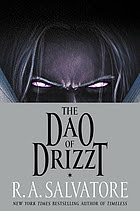
Book Review: The Dao of Drizzt

R.A. Salvatore, The Dao of Drizzt. New York: Harper Collins, 2022. ISBN: 9780063011281. 
 
Genre: Fiction
Subgenre: journals, fantasy
Format: e-book galley
Source: Edelweiss Plus 

 
I admit that it has been a few years since I've read books from the Drizzt Do'Urden series. When I saw this new one coming out and read the title I was intrigued. The title suggested a distillation of Drizzt's lessons learned and wisdom gained over his adventures. The book does some of that, but it could have been distilled further. 

In the novels, Drizzt makes time to write about his experiences and reflect on his life, making sense of his world. He covers such topics as love, life, the divine, good and evil, and more. This book basically repackages Drizzt's journal entries from the novels and related works from the Dark Elf Trilogy books to the Way of the Drow books. 

In essence, this book is a collection of excerpts from the novels and works featuring Drizzt Do'Urden. The excerpts focus on the character's writings and reflections. Rather than getting the lessons, aphorisms, and other bits of wisdom, we do get lengthy excerpts that vary in length and quality. Some passages are more interesting than others, and some often just seem to ramble on a bit. The galley had 371 pages (the publisher puts the book at 432 pages), and it feels long. Some more selective editing and conciseness could have made this a better and more meaningful read. Just offer the lessons and trim the rest of the text. 

The book is clearly for fans of the series. Readers who have read most or all of the series may appreciate this the most if they wish to have the dark elf's writings in one place. For more casual readers, this book may be a mixed bag. Some material is not that interesting, but your mileage may vary. 

I'd consider this optional for public libraries. For libraries that collected the series and kept it, they may want to add this to the collection. For others, as I said, optional selection. Not recommended for academic libraries unless they have a very strong fantasy and pop culture collection. 

For me, this would be one to borrow. For fans and collectors, it may be essential. It was just OK for me. 

2 out of 5 stars. 

This book qualifies for the following 2022 Reading Challenge: 


Friday, June 05, 2020

Booknote: Underboss (audiobook edition)

Peter Maas, Underboss. New York: Harper Collins, 1997.

(link to WorldCat print record as I could not find the exact audiobook record for the edition I listened to. I think today you can probably get it in places like Overdrive)

Genre: nonfiction, autobiography
Subgenre: Mafia, mobsters, true crime
Format: audiobook
Source: Online. It was on YouTube of all places, and I just casually decided to listen to it. On a curious note, the recording online was taken from cassettes, so every so often the audio instructed the reader to turn the cassette over. That does bring back memories.


This is a short quick review of the book. I read it as an audiobook while I was doing some work, so I did not take notes on it for possible review. So here are some quick impressions so I can remember that I read it.

This is the story of Sammy "The Bull" Gravano, who was John Gotti's underboss in the Gambino crime family. Gravano pretty much brought down Gotti and the crime family when he turned government witness.

The book is actually pretty interesting, especially the early years when Gravano is rising in the Mafia. We get a look at not only the Mafia's corruption, but the corruption throughout New York City as well. Gravano makes an effort throughout the book to emphasize how he strove to go by the rules of Cosa Nostra, rules that he saw the family under Gotti was not following. According to him, the family under Gotti was not the true Cosa Nostra. However, we do need to recall that Gravano and the rest of the Gambinos were a criminal enterprise engaged in various crimes ranging from racketeering to murder. In fact, Gravano was involved in his own share of murders. Basically, a lot of the effort in the book is to make Gravano come across as somewhat sympathetic. I will leave it to readers to judge.

The narrator of this audiobook overall is pretty good. The narrative goes from Gravano telling his story to the narrator then reading other parts of the text where Gravano is not speaking directly. The voice remains fairly consistent, so there may be a moment or two you may lose track of who is speaking. Still, it is a pretty good listening experience.

Overall, I did like the book. It was not great, but it was pretty good. For fans of books about the Mafia and readers of the true crime genre, this may be a good selection. For folks particularly interested in John Gotti, they may want to read this book as well.

3 out of 5 stars.

Book qualifies for the following 2020 Reading Challenges:


Friday, November 22, 2019

Booknote: The Hellbound Heart

Clive Barker, The Hellbound Heart. New York: Harper, 2007 (reissue edition). ISBN: 978-0-06-145288-8.

Genre: fiction
Subgenre: horror
Format: paperback
Source: Berea branch of the Madison County (KY) Public Library


A while ago I watched the film Hellraiser, and while I liked some elements of it, I was underwhelmed with the film overall. So I decided that some day down the road I would read the novella it is based on: The Hellbound Heart. Lucky for me, my local public library recently got a reissue edition of the book, so I checked it out. This edition is nothing special in the sense that it does not have any introductions, new notes, or any other supplements that get added to classics years later. In other words, it had just the text so I could read and judge on that basis. Also, the text on this edition is a bit larger, so the total pages is 164. You can read this in one sitting if you wish and have time.

My initial impression on seeing the movie was Barker is a better writer than movie maker (he did direct the film that adapted his novella). Sure enough, that was true. The story offers a lot that the film leaves out, and it has more details and richness to it. Plus, it does it in 164 pages making this a nice, tight narrative that is a good horror tale without a lot of fluff. The book originally came out in 1986, a time when a lot of schlock horror and slasher stories were popular. So yes, Hellbound Heart broke that mold with something innovative. What interest me is that the story is very good and it still works well today.

Barker draw you into the story, and once it starts, he sustains the suspense until the end. The basic plot is well known: Frank Cotton's opening of the puzzle box, opening the way for the Cenobites to take him, and Julia, his lover, who is married to Frank's brother, working to bring Frank back to life. Even if you know the basics, you should read the novella where it all starts. For one, it is well written and literary. Two, there are many rich details in the tale not seen in the film. Three, while Barker develops the Cenobite myth, there is a lot of room for growth. A lot of what we get are hints, indications, ideas, just enough to keep readers intrigued. We should note a lot of the Cenobite mythos, including details like naming the apparent leader "Pinhead," were spun with or after the film. None of them were part of the novella, so a challenge for modern readers already exposed to other media is to read the novella with fresh eyes. That is what I tried to do, and for me, I got a better appreciation of what came later from reading the novella. As I said, it is well written, concise, and has enough detail to draw the reader into its world and make one want more.

The book is a classic of the horror genre, and it is well earned. I'll add that I've read a bit of Barker's other works, and expansive as they can be, they just do not have the same sense of simple yet deep wonder Hellbound Heart has. I like that despite all the spins over time, this original tale holds up well.

Overall, I really liked it. This is definitely a good selection for libraries, specially for horror collections. Whether they select this edition or a different one, this is a must have in a horror collection. I like this particular edition because it is just the text with no fillers, but your mileage may vary.

4 out of 5 stars.


Friday, April 12, 2019

Booknote: Reader, Come Home

Maryanne Wolf, Reader Come Home: the Reading Brain in a Digital World. New York: Harper, 2018.   ISBN: 978-0-06-238878-0.

Genre: nonfiction
Subgenre: brain science, reading, technology, literacy
Format: hardcover
Source: Berea branch of the Madison County (KY) Public Library


This book looks at brain science and what effects increasing technology have on things like critical thinking, empathy, and reflection. It's not quite a jeremiad, since the author does not totally condemn technology, but it is not necessarily optimistic either.

The main issue of this book is that  it is dense at times and very repetitive. The author often repeats points over and over, and you just say yes  I got it, can we move on already? In addition, the book is dense because the author throws in every quote and citation she can find. Even though she is a researcher, more often than not she just keeps piling up references, quotes, and citations from other people. To be honest, it often feels like an undergraduate paper where the student, lacking any original ideas of their own, tossed in all the research material they found to hide their lack of substance. I heard voices of a lot of scholars but not her own voice.

I picked this book up because as a librarian I have an interest in learning about readers. The book does make some good points, including a chapter for parents on raising children in the digital age. Overall, the author writes her chapters as letters, but there is no real epistolary form here. It is basically essay chapters like any other book.

If you read her previous book, Proust and the Squid, you might enjoy this one. I have not read the previous book, and based on this one I have no intention of reading the other book. This book was mainly OK, and I suggest it as optional reading if you must. Borrow it if you must.

2 out of 5 stars.


Additional reading notes:

On the significance of reading. Note also there is a mention about the quality of your reading:

"What we read, how  we read, and why we read change how we think, changes that are continuing now at a faster pace. In a span of only six millennia reading became the transformative catalyst for intellectual development within individuals and within literate cultures. The quality of our reading is not only an index of the quality of our thought, it is our best-known path to developing whole new pathways in the cerebral evolution of our species. There is much at stake in the development of the reading brain and in the quickening changes that now characterize its current evolving iterations" (2). 


On the importance of reading broadly, deeply, and keeping up your background knowledge:

"There is also a Matthew-Emerson Effect for background knowledge: those who have read widely and well will have many resources to apply to what they read; those who do not will have less basis for inference, deduction, and analogical thought and makes them ripe for falling prey to unadjudicated information, whether fake news or complete fabrications. Our young will not know what they do not know" (56, emphasis in original). 

The above also explains the presence of so many barely literate dumbasses who label as "fake news" anything they dislike, misunderstand, or disagree with. They just lack background resources to apply in their reading, if they even read at all. By the way, Matthew Effect refers to the concept by Merton. The Emerson part comes from his "The American Scholar" speech (Wikipedia entry;  actual text of the speech).  The Emerson quote the author mentions in the book as part of this context:

"When the mind is braced by labor and invention, the page of whatever book we read becomes luminous with manifold allusion. Every sentence is doubly significant." 


Last thing we need, but we are getting more of anyhow, and not just young people:

". . .the last thing a society needs is what Socrates feared: young people thinking they know the truth before they ever begin to arduous practice of searching for it" (75).

Some disturbing reading issues for Black and Latino children:

"More disturbing altogether, close to half our children who are African-American or Latino do not read in grade four at even a 'basic' reading level, much less a proficient one. This means they do not decode well enough to understand what they are reading, which will impact almost everything they are supposed to learn from then on, including math and other subjects. I refer to this period as the 'vanishing hole in American education' because if children do not learn to read fluently before this time is over, for all educational purposes, they disappear. Indeed, along the way many of these children become dropouts with little hope of reaching anyone's dream when they grow up" (152). 


Naturally, the government plans ahead for those dropouts, including providing more business for certain private contractors. Well, not quite, but here is the quote first, then I will explain:

"The Bureau of Prisons in states across America know this well; many of them project the number of prison beds they will need in the future based on third- or fourth grade reading statistics" (152). 

Now, I admit that sounds pretty good. It sounds like the kind of thing the federal government would do. However, it turns out it is NOT true. The Atlantic ran an article back in 2012 debunking this idea, but they did remark that "it should be true." By the way, this was fairly easy for me to verify, so it irked me that the author was so casual about including the myth without verification. Did she not check? Did  she not have an editor or fact checker that could have alerted the author to the  error? It may seem like a small detail, but it does reduce the author's credibility. What other "facts" did she include that sound true but may not be?

Moving on, the Council on Foreign  Relations sums up the big issue for the United States. I'd say we have already reached this point. Just  look at the 2016 electoral results, though this has been building up since at least the Reagan years:

"Large, uneducated swaths of the population damage the ability of the United States to physically defend itself, protect its secure information, conduct diplomacy, and grow its economy" (152).

So how bad is it?

"Only a proficient reading level will ensure that an individual can go on to develop and apply the sophisticated reading skills that will maintain the intellectual, social, physical, and economic health of our country. Two-thirds or more of future US citizens are not even close" (152). 


Johnathan Kozol in his books says that putting money in schools does make a difference, contrary to what ignorant or selfish assholes often say. Wolf emphasizes the need to invest in education, especially early education. Americans can either choose to invest in educating all its children starting early, or they can keep building prisons while the rest of the world that does invest in education gets ahead and leave the U.S. behind.

"Simply put, the amount of money we invest in the first years of a child's life produces greater returns for each dollar spent than at any other time in the life span" (153). 

On the importance of deep reading:

"Deep reading is always about connection: connecting what we know to what we read, what we read to what we feel, what we feel to what we think, and how we think to how we live out our lives in a connected world" (163). 

Again, on why the undereducated are a problem:

"The atrophy and gradual disuse of our analytical and reflective capabilities as individuals are the worst enemies of a truly democratic society, for whatever reason, in whatever medium, in whatever age" (199). 


Sunday, December 24, 2017

Booknote: Will and Abe's Guide to the Universe

Matt Groening, Will and Abe's Guide to the Universe. New York: Harper Collins, 2007. ISBN: 978-006-134037-6.

Genre: comics and graphic novels
Subgenre: humor (barely)
Format: trade paperback
Source: Berea branch of the Madison County (KY) Public Library 

This is one of Groening's early "other than the Simpsons" stuff, and to be honest, it is not really that good. The premise of the book is that Groening gets ideas from his sons' conversations, songs, made-up stories, etc. It's sort of his attempt at "Kids say the darnedest things," only that kids are not really that funny. The whole thing just falls flat. There are one or two funny strips, but overall you can safely skip this unless you feel a need to read everything Groening has written. I certainly do not. Borrow this one if you must.

2 out of 5 stars (barely)

This book qualifies for the following 2017 Reading Challenges:


Friday, June 30, 2017

Booknote: Friends of the Family

Tommy Dades and Mike Vecchione, with David Fisher, Friends of the Family: the Inside Story of the Mafia Cops Case. New York: Harper, 2009. ISBN: 978-0-06-087427-8.

Genre: nonfiction
Subgenre: true crime, police corruption, Mafia, the mob, New York City
Format: paperback
Source: Berea branch of the Madison County (KY) Public Library


After reading Casino and The Way of the Wiseguy (links go to my reviews of those), I wanted to try out the true crime genre a bit more. I saw Friends of the Family at the library. It seemed interesting, so I picked it up. It is the kind of story  that might make a decent made-for-television movie but not so much a Hollywood film.

This is the story of two cops, Louie Eppolito and Steve Caracappa, who went on to be highly ranked and decorated NYPD detectives. They also became paid hit men for the mob and moles for the mob inside the police. At the time, this was the biggest scandal and betrayal of the badge the NYPD had ever seen. They almost got away with it. They were not caught at the time, and they happily retired to Las Vegas, Nevada in the 1990s. They were living the good life. A decade later, another NYPD police detective, Tommy Dades, who is close to retirement, takes a long look at the case, and working with Brooklyn ADA Mike Vecchione, brings the case back to life, turning it into a historic case.

The book has drama, and suspense, and characters you can root for. It also has a lot of procedural details. If you like reading about the work investigators do behind the scenes and about legal wranglings, this book is for you. Those are the not so glamorous parts that don't make it into legal dramas but make the bread and butter of police work. So you may find it interesting or a bit slow reading at times. Then you get to a real infuriating part, the legal maneuvering for fame and glory. Brooklyn started building a case the feds all but forgot. The moment the feds sniffed a chance at press and glory, they did every cheat, lie, and trick to steal the case from the city, even reneging on deals they made with  the city for collaboration, so on. That part I found particularly disgusting because the feds showed that justice did not matter as much as getting headlines even if it meant taking credit for work they did not do. Despite that, the cops were eventually taken to trial, but getting them there took a lot of drama.

The book's pacing varies. It has parts where the narratives moves fast and draws you in. Then it has other parts where it slows down, and at times it may get bogged down in minutiae. So in terms of reading experience, it can be a little inconsistent. Yet overall it is a dark tale of corruption and justice served. Overall, I liked it. It's a book to read once and enjoy; certainly a book to borrow.

3 out of 5 stars.

* * * * *

Additional Reading Notes:

So, how bad were these cops? Well, at the time, nothing like this had happened. The closest thing was a 1914 case of an NYPD lieutenant who was associated with street gangs. The two cops' damage was so bad we may never know all of it:

"The extent of the damage that Eppolito and Caracappa did to the department may never be completely totaled. They gave up informants to the mob, who murdered them. They informed the mob about wiretaps and investigations, they warned men who were about to go on the lam, they forced innocent people to confess to crimes they hadn't committed by threatening to kill their families, they provided whatever  information the mob needed, they kidnapped people and turned them over to wiseguys to be tortured and killed, and finally they put on their badges, pulled their guns, and murdered at point-blank range. There's no possible way of figuring out how many investigations they destroyed, how many people died because of them" (7). 

Turns out that, as if all else was not bad enough, the two cops even had instances of passing on the wrong information:

"Casso found out they'd wacked the wrong Nicky Guido from the newspapers. According to the story in the papers, this Nicky Guido was an installer for the telephone company. The murder of Nicky Guido had been a simple mistake. The two cops had provided the wrong address. No one knew what the intended victim looked like, so they had killed an innocent person" (87). 

One way investigators fill in information gaps:

"There are information gaps in every investigation. Usually, they can be filled in by putting together causes and events, what had to happen to enable the next action to take place. It's a leap of information, sort of the way a nerve impulse will leap across a synapse from one neuron to another" (146). 


* * * * * 

This book qualifies for the following 2017 Reading Challenges: