Showing posts with label Llewellyn. Show all posts

Friday, July 31, 2026

Book Review: Pagan Curiouser

Debra DeAngelo, Pagan Curiouser: a beginner's guide to nature, magic & spirituality. Woodbury, MN: Llewellyn, 2026. 
 
Genre: nonfiction
Subgenre: Paganism, inspirational, guides, spirituality
Format: e-book galley
Source: Edelweiss Plus
 

This book is a guide for folks interested in becoming a practicing pagan. Paganism is a very broad umbrella, so the author keeps the focus a bit broad, so you can build up a joyful, meaningful, and unique path that is yours. The book is a follow up to her previous work, Pagan Curious (link to my review). If you read the previous book, and you are still working on your pagan path, you will want to read this one. However, having read both, I'd say you can read this one just fine without reading the previous one. I personally liked this one better. 

The book is arranged in three major sections with 15 chapters. The material builds up from self to your surroundings to the magical path. The book also features a bibliography for sources cited, which you can use for further reading. The bibliography includes books and online resources. There are some academic online sources listed, but most of the online items are popular resources. In addition, the book features activities for readers that are conveniently listed in the front of the book. 

I found this book more interesting to read than the previous one. It also is a bit more focused. You get the chapters with the lessons, and each chapter ends with activity. For the most part, the activities are not difficult. Many of them don't even require materials other than yourself willing to do a little work. I found the book easy to read. 

If you are starting on the path from scratch, this book is a pretty good option. The content is a bit broad and general to allow readers to decide how to build their paths. You can take what works for you, leave the rest. You can explore and experiment, then decide what you want in your practice or not. While the author does mention elements of her own pagan practice, it does not mean you have to follow her practices. View them as examples of things you could do. I'd say if a specific element or practice calls your attention, do your research and see where it leads. 

Overall, I really like this book. I think it is a good entry point for folks interested in a pagan path, including those who want magic in their craft. I would recommend it for libraries that collect pagan and esoteric materials, especially public libraries. For academic libraries if they already have strong collections in paganism and/or religion, this could be a good selection. If you have students curious about paganism, this book may be a good selection. 

The book may be optional for pagans who are well settled in their paths and crafts. It may be a bit basic for them. For me, still learning, it's a good resource. 

4 out of 5 stars. 


Additional reading notes: 

On pagan's connection to the world: 

"Pagans are deeply connected to the natural world. We don't view it as something we are in,  like visitors passing through. We aren't in nature, we're part of it. Protecting the environment is a fundamental Pagan value. Reverence for our planet and a deep, spiritual connection to nature is the foundation of a Pagan life. Making choices that harm Gaia is Pagan sacrilege" (113, emphasis in original). 


A definition of mindfulness: 

"Mindfulness means being completely aware of what you're doing. Being mentally present and fully experiencing that exact moment rather than going through the motions while your faraway mind whirls and swirls in a mental multiverse. It means being here now" (36, emphasis in original).   


On the pagan connection with Spirit: 

"Pagans strive to keep our connection with Spirit open and flowing. We recognize Spirit expressing itself in our lives and hearts, and we embrace a Spiritual life" (62).


Pagans, on their values shaping their spirituality. This one resonated with me a bit: 

"You aren't obligated to keep legacy values. You're a Pagan now. Wipe all that spiritual sludge away and declare your own values. Going forward, you will decide which values to keep and which to jettison. You will shape your own spiritual values from now on. Those who gifted you with those legacy values may get very upset when you choose a different direction, because someone who says no challenges their beliefs and makes them feel insecure. Step away anyway.

When faced with objection or resistance, stand spiritually firm. Make your spiritual boundaries robust and unassailable. You aren't required to defend or debate your values to anyone, unless you want to.  You don't owe anyone an explanation, and you aren't required to attend every argument you're invited to. You can just say I understand that you disagree and drop it" (66, emphasis in original).


If you are working with a deity, respect is essential: 

"Respect is the foundation of a relationship with a deity. Become a perpetual student of their lore and history. Become fascinated with that deity, and the rest will follow" (70). 


I found the section on "Pagan Self-Defense" an important read. It feels like the kind of thing that established pagans take for granted, but they fail to tell the new folks. As I am writing this I feel that this book at times demystifies paganism for newcomers. This is not unlike some of the work I do demystifying academia for some of my students. So there I go again finding similarities between paganism, or at least my pagan path, and librarianship, or at least my path in the profession. Maybe I need to write on that a bit more sometime, but let us not digress now. 

On another side note, the passage to be honest, made me briefly reconsider if I should take down the small altar I keep in my work office. While it has not been an issue, there are moments I wish I was a bit less visible as a pagan because one never knows what may or not happen. For now, it can stay up. At any rate, people do have to step into my office and look at the back to see it. Most folks who visit my office either stay near the office entrance or sit in the consult area in front of my office, so no big deal. 

On an additional side note, my talk last spring at the campus Spiritual Seekers group I am sure added to my visibility, but I did walk into that voluntarily; the chaplain did ask nicely. But that is another thought for another time. 


Back to notes from the book, on the power of silence, which is something I find myself embracing more best I can: 

"Staying silent is a key principle of the Witches' Pyramid: To Know, To Will, To Be Silent" (183). 

On a side note, I know I've read that phrase elsewhere, but at the moment I can't recall where. 


Defining magic:

"At its most basic, magic is a specific goal or desire that you energetically propel to the Universe for completion by doing particular things a particular way. It is willfully directed, focused energy that results in change. Magic has three basic parts: intention, implementation, and manifestation" (187). 


Be specific with your magic works: 

"Don't leave too much interpretation up to Spirit, because it's wildly creative, and sometimes has a wicked sense of humor. Be specific" (191). 

As a devotee of the Cosmic Joker, learning this is a work in progress, though at times you just have to accept and embrace the Divine Humor. 

And speaking of the Divine Humor: 

"Bad shit happens. How we interpret and deal with that is what separates magical people from everyone else-- we're confident that Spirit diverted as much tragedy as possible. A magical, Pagan life doesn't mean everything will be charmed and wonderful from now on. You'll celebrate life's sweetness, but when it sours, you'll have extra coping skills: your magic and your Pagan perspective. Magic is available all the time and provides comfort when things are difficult and dark. We'll embrace joy and positivity, but when the water gets choppy, you can cling to your trust in Spirit. You're never truly alone. Spirit is always there. Always. 

Trust that the Universe has your back too" (198).


A reminder, do the work and practice: 

"Magic is a skill, and like any other skill from calligraphy to woodworking to juggling, you only become proficient with practice" (251).     


Book qualifies for the 2026 Netgalley/Edelweiss Reading Challenge: 


Friday, July 10, 2026

Deck Review: Whispers of Time Tarot

Sonya Kulynyak, Whispers of Time Tarot. Torino, Italy: Lo Scarabeo, 2025. ISBN: 9780738781594.  Distributed in the U.S. by Llewellyn Worldwide (link to Llewellyn).

Genre: Tarot decks
Subgenre: classical art, mysticism 
Format: 78-card deck and small companion book in box
Source: I own this one  

The Hierophant-V 

So far this may be one of the most beautiful decks I've used in 2026. The kit includes the 78-card deck and a small companion book. It is published by Lo Scarabeo, so the book's text is in multiple languages: English, Italian, Spanish, and Portuguese. The book has 178 pages; the English text has 65 pages. The small book is arranged as follows: 

  • Introduction. Where the author briefly explains the deck's concept and provides a bit of advice on reading the cards. 
  • The Spreads. We get three card spreads you can try out. 
  • The Cards. Here are the card entries. Card entries include a short list of keywords and the interpretation text. The Minor Arcana entries also include a keywords list, but the interpretation text is a bit shorter than the text in the Major Arcana entries. 

All in all the interpretations are good in describing the card symbols and providing meanings. Interpretations fall well within Rider Waite Smith (RWS) system. Book is accessible and easy to read. For beginners it provides what is needed. If you are experienced, can you read the cards without the book? Yes. If you read in RWS tradition, you could skip the book. I read it, and I still suggest others read it just to see what insights the author provides. 

The deck features art in a classical style that evokes mysticism with a bit of magic and daily life. Art has a realistic style. It is colorful and expressive. Faces convey emotions very well. Art also makes use of shadowing very well. Given how expressive it is and its attention to detail, I'd say the deck can work well intuitive readers. 

Eight of Pentacles
I enjoy this deck for its classical art style. It feels traditional, and it is a deck you can use to read for yourself and others. The art feels like it could be found in a museum. It's art that invites you to look deeply and meditate on what you see. It could also be a good option for shadow work. 

The cards measure about 4 3/4 inches by 2 3/4 inches. Card stock is a bit on the thick side, so it feels durable. The finish is a soft matte, so the deck can be shuffled easily. A nice touch is the golden gilded edging. 

Overall, I love this deck. I found it to be a reliable reader, responsive, easy to use. It also just looks good when you lay them out. I was reluctant to put it away when I did my monthly deck rotation, so I know I will be reaching for it again soon. This is one I would be happy to get a back up copy. It can also be a good gift, especially for folks who enjoy classical art styles. I am very happy to have it in my collection. 


5 out of 5 stars.  

Monday, May 04, 2026

Short Book Review: Alhazred

Donald Tyson, Alhazred. Woodbury, MN: Llewellyn, 2006. ISBN: 9780738708928. 

Genre: fiction, horror
Subgenre: esoterica, Lovecraftian 
Format: trade paperback
Source: I own this one 
 

After reading and liking Tyson's Necronomicon (link to my review), I started reading Alhazred to get the "biography" of the author of the Necronomicon.

The book starts pretty strong, As a young man, Alhazred is an adopted prince. When he is caught having an affair with the king's princess, the king tortures, castrates him, and then leaves him to die in the desert. Disfigured, Alhazred manages to survive. From there, he does anything necessary to survive, becoming a necromancer along the way in the hope of restoring himself. 

Necronomicon was a relatively fun to read book and interesting at times. Alhazred after a few chapters just goes off the rails. After a while, the story just keeps meandering and going on and on. . . and on and then on further. I speculate the author lacked a good editor to help him cut out some of the filler. This book does feel like it has a lot of filler. Alhazred is an interesting character, and his dive into necromancy and dark magic could be a good story. However, the novel's length and meandering just gets tiring. 

I read this book also because I have Tyson's Necronomicon Tarot deck, which I hope to use soon. I'd say you can likely read the book Necronomicon, and skip Alhazred unless you are a completist. The Tarot deck does have a good companion book if you want to dive in.

Overall, this is a book I do not recommend. I would consider it highly optional. Tyson has written other Necronomicon works, and I may try to read them down the road, but I am no rush to do so. 

1.5 out of 5 stars. 


This book qualifies for the following 2026 Reading Challenge: 


Wednesday, April 15, 2026

Deck Review: Runic Tarot

Jack Sephiroth, et.al., Runic Tarot. Woodbury, MN: Llewellyn Worldwide, 2021. ISBN: 9780738770734. (link to publisher)  

Genre: Tarot decks
Subgenre: vikings, Norse
Format: Kit with companion book and deck
Source: I own this one  


The Fool-0 
Up front, if you liked the Heaven and Earth Tarot deck (link to my review), you might like this one. JackSephiroth, artist and author of the Heaven and Earth Tarot, is the artist and author for the Runic Tarot. The art style here is similar to his other deck, which is a reason why I picked up this kit. Allen Dempter also worked on the deck's concept and did the runes research. Jaymi Elford wrote the book. A book by Elford is another good reason to pick up a deck kit. So we are off to a good start. 

The deck kit includes the companion book and the 78-card deck. The book is arranged as follows: 

  • Runic Tarot. A small runic meditation to set up mood and get started working with the deck. 
  • Introduction to Tarot. Briefly introduces the deck's concept combining runes and Tarot. We also get a short overview of Tarot structure. 
  • Introduction to Runes. A brief overview to runes. We also get a table of runes. 
  • Unlocking the Meanings. Some advice on using the book as starting point for your journey with the Tarot and runes. 
  • Major Arcana. First we get a table showing which Nordic deities and runes connect to Major Arcana cards. Then you get the Major Arcana entries. Each entry includes a full color illustration of the card, image description, meanings, keyword for upright and reversed interpretation, and interpreting the runes. 
  • Minor Arcana. Entries are arranged by suits. Note each suit draws from different runes. For example, runes in the suit of horns (cups) are drawn from the Medieval Futhark.  The card entries here lack illustrations. You get image description, meanings, keywords upright and reversed, and interpreting the runes. The text is shorter than in the Major Arcana entries, but you get enough to work with the cards. 
  • Reading Tarot. This includes brief instruction on using the cards, runic spreads featuring 3 spreads, and a list of steps to do your first reading. If you're experienced you might skip the last page, but I'd say try the steps anyway to reinforce learning. 

The book is accessible and relatively easy to read. When it comes to the runes, you get the basics. If you know runes and/or work with runes, you may appreciate the integration with Tarot better. If you come with no knowledge, and you are curious, you may want to seek some supplementary reading on runes. Still you can use the deck and book just fine even if your knowledge of runes is limited. 

Eight of Shields (Pentacles) 
The card art is beautiful with a bit of an ethereal quality. If you like vikings, Nordic mythology and imagery, you'll probably like this deck. The deck has some Rider Waite Smith (RWS) elements, but much of the art offers unique elements that can add to your readings and interpretations. 

The cards are fully illustrated. They feature images that you can take your time looking at them. They are rich in detail and expressive. They are colorful with grey tones predominant. I'd say this is a good deck to use during the winter season. Of course, you can use it any time of year, but for me it works well in winter. If you work within the RWS system, this deck can work for you. The deck can work well for intuitives given the rich and expressive art. 

Each image in the deck features one rune or more. A small issue is the artist drew some of the runes too small or hid them too well in the art. There are one or two cards I could not see the runes; I realized a rune was there after reading a card description. I found this is a significant issue on some cards. 

On a side note, there is a mini-edition of this deck available, so if you cannot see some runes on the standard size deck, the issue may be worse in the smaller size. Despite that, I may get the small edition for my work office. 

Overall I love the deck. I found it to be a solid reader, reliable, and responsive. It works for me, In addition, it has made me more curious about runes, so I will start studying them down the road. I am gathering some study resources already. 

If you like Runic, viking, Norse art and beliefs, and you read Tarot, this is a deck for you. If you work with runes, this deck may be for you too. I do highly recommend it. It is one I'd consider getting a back up copy. 

5 out of 5 stars.


This deck kit qualifies for the following 2026 Reading Challenge: 


Wednesday, February 25, 2026

Book Review: Become an Exceptional Tarot Reader

Ethony Dawn, Become an Exceptional Tarot Reader. Woodbury, MN: Llewellyn, 2025. ISBN: 9780738779225 (link to publisher.)

The publisher describes this book as a "culmination of Ethony Dawn's 20+ years teaching tarot." If you want to learn how to read Tarot, and you need an accessible book that is practical and down to earth, this book is a great choice. This is a book written by an experienced Tarot teacher for learners who want to read cards with confidence. I found the book to be interesting, and I learned some new ideas as an intermediate card reader. 

The book is arranged as follows: 

  • Exercise list. The list of exercises featured throughout the book, so you can find them with ease. 
  • A foreword by Theresa Reed. 
  • Introduction. Here Ethony tells readers how to read and work with the book. She tells us to read it in order, but you can also use it as a meanings reference book for your practice. In the introduction, Ethony tells a bit of her own story, an overview of Tarot history, and presents the first exercise. 
  • Ten chapters. Topics include Tarot basics, the Tarot journey, numerology, and the card entries. Each card entry includes an RWS card image, an affirmation for the card, description of classic imagery, card astrology, and upright and reversed meanings, keywords, and interpretations for various types of readings. You also get some journal prompts for each card. For learners and practitioners like me you get a lot of value and working material in the entries. 
  • Conclusion. A reflection on what you've learned and encouragement to keep on studying and earning. 
  • Tarot reference tables. These are tables with basic upright and reversed keywords for each card. If you need a quick cheat sheet, this works. 
  • Recommended reading. Ethony lists two of her other books and her resource website. She then lists other books from other authors you may want for your personal Tarot library. 
  • Bibliography. The works cited. This list also has books you may want to consider for your Tarot and esoterica library. 


As I stated, you get a lot of value and good information from this book. If you read it in order as Ethony suggests you get a solid learning plan that takes you through the basics. The lessons build on each other. A strength of the book is in the exercises. You get exercises throughout the book to help reinforce and apply what you learn. Many exercises include writing and journaling, which I find  very valuable in my own practice.  

The book is an easy read, but it is one to study at a steady pace. Take your time reading it and doing the exercises, especially if you are a new learner. More advanced practitioners may be able to browse and find exercises of interest to try out. For me, this is a book I want to go back and do the exercises. I also agree it makes a very good Tarot reference book with substantial card entries. 

Overall, this is a solid Tarot book I'd want on my Tarot library. If I was gifting someone a Tarot deck, I'd be happy to give them this book as a gift as well. Ethony has written an excellent, easy to read learning guide. This is a book I highly recommend for new and continuing learners. I also recommend it strongly for libraries that collect Tarot and esoterica books. I'd say this book is essential. 

5 out of 5 stars.  


Additional reading notes: 

From Reed's foreword: 

"The Exceptional Tarot Reader is bound to become a well-worn book in your tarot library. Everything you need to know about tarot covered in the book, from the origins of the cards, to how to care for them, plus spreads, interpretations, and reversals. All of this is explained clearly, in her straightforward, friendly way. While it's designed for beginners, even seasoned readers will find value in Ethony's wisdom" (xiv).


On what Tarot does: 

"The tarot is designed to allow the user to transfer their knowledge from one deck to another. To build a foundation based on archetypes through a rich symbolic language that grows and evolves alongside the person reading the cards. The tarot allows people who read and study the cards (querents) to see themselves and others when they conduct a tarot reading" (4). 


As a reader work to make things better: 

"As a reader or guide, you should always try to make the world a better place, even if your querent is going through a rough time, and this will show in the cards. You'll learn how to handle difficult cards and situations in your readings, not to shy away from the 'harder' cards in the deck and how space for yourself and your querent in rocky times" (8).   


A reminder to keep on learning: 

"As much as you've learned throughout this book, there is always more to discover. The beauty of the living art of tarot is that it will surprise and challenge you, keeping your practice fresh and dynamic" (372).  


 This book qualifies for the following 2026 Reading Challenge:


Wednesday, August 13, 2025

Book Review: Talking with the Tarot

Samantha Rose Hicks, Talking with the Tarot:  conversations with your 78 new best friends. Woodbury, MN: Llewellyn, 2025. ISBN:  9780738778433. 

Genre: Tarot
Subgenre: dialogue, learning
Format: e-book galley
Source: Edelweiss Plus  
 

In my cartomancy and magical path I have read quite a few books including Tarot books. I know there are still many more books to read and study, but that is a thought for another time. One detail I have observed over time is that Tarot books often present a method or technique. It seems that for many Tarot books the authors offer a way, their way. Whether this method is fearless, through magic, with rituals, or pathworking, authors often have a method or way. The ones I have read so far are good books overall, but I can also see these techniques as their way to distinguish themselves from another book of card meanings. Sure, many of these books do offer card meanings, so as I read I look for a different perspective, technique, spin on the cards. With that context I have read Talking with the Tarot

The approach for this book is to have a conversation with your cards, a very casual conversation. The idea is to know your deck in a casual, informal, and friendly way. 

The book features a foreword by Elliot Adam. After the preface and introduction, the book offers 11 chapters. 

  • Chapter 1 goes over Tarot structure. 
  • Chapter 2 looks at the Major Arcana. 
  • Chapters 3 to 6 look at the Minor Arcana by suits.
  • Rest of the chapters expand on technique, spreads, and even a bit about professional practice. 
  • Book ends with a conclusion and a small bibliography.

The strength of the book is in the conversational style and method presented. Esoteric elements are kept to a minimum, which makes the work very accessible. The text is also easy to read. I read it cover to cover so I could write this review, but this is a book to read a bit at a time. 

Each card entry features an opening interpretation, talking to the card in conversation, creating a personal connection, and reversal prompt questions. Within these subheadings, the author shows how to have a dialogue with the cards. The author tells us what each card offers, what advice they bring, and what life experiences they represent. The Major Arcana entries have a bit more substance but otherwise the content for all cards is about the same. 

Note that the author offers a statement on reversals and how to read them, if you so choose, early in the book. In entries,  you get some prompt questions to explore reversals, but otherwise there is no pressure to read reversals. 

This is definitely a very beginner-friendly book. It is easy to read, very straightforward. It is not complicated, and as you read it feels very conversational, like people just hanging out in the porch. Still, it does offer substance, symbols, etc., but it does so without pretensions nor formality. Though the book is geared to the traditional Rider Waite Smith (RWS) system, as long as you have a deck that falls within RWS you can make it work.

Overall, I enjoyed reading the book, and I am glad I did. It is a nice alternative to more popular but very formal Tarot books out there. Even mid-journey cartomancers like me can get value from the book and learn some new things. I highly recommend the book for libraries that collect pagan and esoterica materials. It is a very good text to recommend for beginners. 

5 out of 5 stars. 


Additional reading notes:  

Elliot Adams describing this book in the foreword: 

"This lovely little book can help you interact with the cards, not as a pile of definitions to memorize, but as a gathering of old friends just waiting to get reacquainted. Samantha's unique method surpasses the act of absently reciting another person's card interpretations. Instead, she encourages you to listen-- to truly listen-- to what each tarot archetype is recalling in your own life experience" (xiii). 


Describing the Tarot: 

"The tarot has become a universal language, using its archetypes and symbols to speak to us. It holds up a mirror to our experiences of loss, love, growth, and spiritual transcendence. It doesn't care where you were born or what language you speak. The tarot steps forward as a tool for universal connection. We see our reflections within the cards every time we call upon them for clarity, perspective, and direction" (5). 


Questions you can ask the cards to find deeper meanings: 


  • "What are the colors of the backgrounds?
  • What do you see going on in those backgrounds?
  • What are the nonhuman elements shown?
  • What are the humans doing in each card?" (11).


Defining an intuitive reader: 

"An intuitive reader is a reader who relies on their inner knowing or connection to Spirit to interpret the tarot's meanings. They don't necessarily always give the defined meanings of the cards and instead allow their intuition to flow, providing the messages to the clients. 

Is everyone an intuitive reader? Absolutely not, and that's okay. Can anyone be an intuitive reader? One hundred percent!" (214).

 I am intuitive, but I also do use meanings from traditional and not so traditional works. My intuitive gift is certainly a work in progress, and it is part of my own Great Work. 


This book qualifies for the following 2025 Reading Challenge: 


Monday, June 09, 2025

Deck Review: Easy Lenormand

Marcus Katz and Tali Goodwin, Easy Lenormand.Woodbury, MN: Llewellyn, 2015. ISBN:  9780738747125. (link to publisher). 

Genre: Lenormand divination
Subgenre: oracle cards, cartomancy
Format: kit with paperback book and card deck
Source: I own this one.  

Cover of kit box
I have wanted to learn the Lenormand divination system for a while now, and I bought this deck for that purpose. This year I finally decided to bring the kit out and start working with it, This kit includes a paperback companion book and a 36-card deck. The book is arranged as follows: 

  •  Introduction. A brief introduction to what is Lenormand and a small bit of its history.
  • One: The Cards. Before the authors present the card entries, this chapter opens with an exercise to get you reading Lenormand right away. I appreciated the exercise to help you just jump in. After the exercise you get the card entries. For each card entry, you get a black and white card image and text with meaning and interpretation. The text length in the entries may go from a paragraph to a couple of pages. Some entries may include notes on how a card works combined with another. Note that the card images in the book differ a bit from the actual cards; the images in the book have a bit more of an antique look. Still, the images in the book and cards are traditional, i.e. you can clearly and easily recognize the cards. At the end of this chapter we get a note on negative, neutral, and positive cards. 
  • Two: Reading the Cards in Context. This explains how to read the cards, especially cards next to each other. This chapter includes an exercise and some examples of card reading, in a way using parts of a Grand Tableau to build up to the large spread later. This is a chapter I wish had more examples to better understand how to read the cards. 
  •  Three: The Grand Tableau. This chapter introduces the big 36-card spread. It uses smaller spreads to build up to the large spread. It also introduces concepts like the charged card (sort of like a significator). The chapter provides also 3-card and 9-card spreads to practice reading the cards and working your way up. 
  • Four: Zones and Shadows. This chapter helps you learn how to read the Grand Tableau by dividing it into zones. They also add a concept of shadowing, a "slightly quirky element" added by Tali Goodwin. She writes "this might be compared very loosely to tarot reversals" (123). This is an optional element for reading Lenormand, so I leave it up to readers if they want to use it or not. I may consider it after I've developed some mastery in Lenormand. 
  • Conclusion. Closing statement and reminder once more that Lenormand card meanings are literal, way more than Tarot. 

The book provides basic and mostly clear instructions for learning the system. Some instructions are better developed than others, so there is some inconsistency in the content. I do appreciate the exercises because they get you practicing right away. The instructions are not complicated, and they leave room to practice developing your interpretations. 


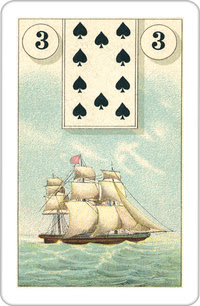
The Ship-3 card 
A small glitch if you will is that a couple of books are mentioned throughout the text, but there is no list of sources or consulted works listing them in one place. That could've been helpful. Overall though we get a good basic instruction book. 

 The cards feature a traditional art style evocative of classic paintings. The card art includes playing card associations. By now, I've collected a few Lenormand decks, mainly for the art but also for future use. I find that I tend to prefer Lenormand cards with the playing card associations. By the way, the book does not discuss the significance of the playing card associations. If this is of interest, you'll need to look for that information elsewhere. 

The cards measure about 4 inches by 2 1/2 inches. They are small but doing a full Grand Tableau spread will still take up some space. Given the basic classic art style the card imagery is clear. The cards are not labeled, but with clear art a reader should be able to identify the individual cards. Cards have a soft glossy coating, and they shuffle easily. The card back art is reversible if you are so inclined. 

In the end, if you are looking to start learning and studying Lenormand, as I am now, this kit is a good option. A topic here or there could use more depth, but overall the kit works to get you started in an easy way. The cards feature straightforward images that work well for Lenormand readers at any level. I'd still suggest this kit for anyone starting to learn Lenormand, more so if you can get it at a sale price as I did. 

4 out of 5 stars. 


This kit qualifies for the following 2025 Reading Challenge: 


Wednesday, March 26, 2025

Deck Review: Steampunk Faerie Tarot

Pamela Chen (author) and Ashley Cassaday (artist), Steampunk Faerie Tarot. Woodbury, MN: Llewellyn, 2024. ISBN: 9780738771496.  (Link to publisher.)

Genre: Tarot decks
Subgenre: fae, steampunk
Format: kit with companion book and 78-card deck
Source: I own this one

The Magician-I

This deck kit includes a companion book written by Pamela Chen and the 78-card deck with art by Ashley Cassaday. The box is smaller then the standard Llewellyn boxes they use for kits, and I really appreciate that detail. The kit takes up less space on the shelf, and it is easier to carry. To be honest, I wish the publisher would pack more deck kits in this type of box. 

The companion book is arranged as follows: 

  • Introduction. Describes the inspiration and concept of the deck. It describe the fae types in the suits: Salamanders (fire/wands), selkies (water/cups), gnomes (earth/pentacles), and sprites (air/swords). You see these fae in the cards, but note otherwise the cards keep the traditional suit names. 
  • Chapter One: Laws of the Land. A brief look at the deck's structure. 
  • Chapter Two: The Mechanics of Tarot. Some basic instructions on handling the cards and doing readings. It includes some advice to write in a journal. 
  • Chapter Three: Major Arcana. Each card entry includes a full color reproduction of the card, card name and number, an epigraph quote, clockwise divination, counterclockwise divination (reversal), and ignition (a bit of additional advice and/or small steps you can take). You get about a paragraph per heading. 
  • Chapter Four: The Minor Arcana. You get the same card entry format as in the Major Arcana. I appreciate the author did not skimp on the Minor Arcana as so many other authors do. 
  • Chapter Five: The Court Cards. Same entry format as previous chapters. 
  • Chapter Six: Magic-Powered Spreads. You get four card spreads here. 
  • Conclusion. 

This is an easy book to read. It has a nice playful and whimsical quality yet it still offers some depth. I enjoyed reading through it. Can you read the cards without it? Given the cards mostly fall within Rider Waite Smith (RWS) tradition, yes, you could. I would still suggest reading the book to get the author's insights and advice from the fae. In addition, it is a well illustrated and colorful book. It is worth reading. 

The art in the cards combine the fae with steampunk. For me, as a fan of steampunk, I knew this deck was for me. If you like steampunk and/or faeries, this may be for you also. The art is colorful, bright, and expressive. It falls within RWS, and it offers plenty of details for intuitive readers. 

Cards measure about 4 1/2 inches by 2 3/4 inches. The card stock is the standard Llewellyn thin stock. It has a light gloss finish. Cards slide and shuffle with ease. The card back features gears art, and it is reversible. 

This is a new favorite for me. I would recommend for readers at all levels. Steampunk fans will likely enjoy it as well as some fae enthusiasts. Overall, anyone can enjoy this fun, solid, and reliable deck. I am glad to own it, and I would be a back up copy. 

5 out of 5 stars. 

This kit qualifies for the following 2025 Reading Challenge: 


Monday, March 10, 2025

Book Review: Tarot Spreads

Barbara Moore, Tarot Spreads: layouts and techniques to empower your readings. Woodbury, MN: Llewellyn Worldwide ,2012. ISBN: 9780738727844.

Genre: Tarot
Subgenre: Tarot and cartomancy spreads, reference, textbook
Format: trade paperback
Source: I own this one. 


By now, it has been about 9 years in cartomancy journey. I use Tarot and card spreads, but so far have not made a spread of my own. It is a skill I would like to learn, so I finally picked up this book. Moore provides a good selection of spreads plus techniques for finding patterns in cards as you read and ways to put spreads together.

The book is arranged into seven chapters: 

  • Chapter 1: Tarot Spread Basics.
  • Chapter 2: Design Principles and Layouts. Yes, there are some principles. At times I wonder why a creator used one layout over another. While I am sure a lot of creators just "wing it," there are some principles to help organize your spread and make it flow better. This idea was new to me. 
  • Chapter 3: A Collection of Spreads. This is the core of the book with classic and other spreads organized by theme.  Some are spreads that Moore has made; others she has gathered from other sources. Moore also describes how she has modified a particular spread and/or offers suggestions for alternative interpretations. You get a lot of value in this chapter. 
  • Chapter 4: Techniques to Add to Any Spread. This features options and ideas you can add to an existing spread. It may be a small change here or there, moving a card, changing your focus and more. 
  • Chapter 5: How to Modify Spreads. Before teaching about making your own spreads, Moore shows us how to modify an existing spread. The idea here is to modify or tweak a spread so it can better meet your needs. You don't have to just make a new spread from scratch if you do not want to do so. Here you work with what you have. 
  • Chapter 6: Do-it-yourself spread design. This is where you make your own spreads. As Moore points out, cartomancers usually have a collection of spreads. I have a few, and I add a new one to me here or there. Once in a while you feel a need to make your own, and this chapter shows you how. The chapter includes examples of spreads Moore has built to illustrate the lessons.
  • Chapter 7: How to do a 78-card reading. I admit this seemed a bit daunting for me, not unlike the Grand Tableau spread in Lenormand.. These are spreads that use all the cards in a deck. However, Moore breaks it down, starting with a smaller spread, then building upon it until  you have all 78 cards in place. 
  • In addition, the book includes a list of spreads (alphabetical by spread name), an introduction, conclusion, spread cross-references (a list of spreads by theme), an annotated reading list (for further reading and learning), and three appendices on old spreads, elemental dignities, and significators. 

A strength of the book is the incremental learning. Moore starts with the basics, and she gradually works her way up. If you are already adept at making spreads, you could skip ahead. For those of us still learning, start reading from the beginning, do the exercises, and build up your own skills and knowledge. Reading through the book I feel that I can learn this. It is not as difficult as I initially thought. 

Moore writes in a simple and clear style. She explains things well. Yes, this is sort of a textbook, but the way she writes she draws you in, and you keep reading. 

I read through the book this time to start learning, get a feel for the book, and to write this review. Having read it, I know this is a book I want to keep handy. I will read it again to try some of the spreads and when I feel ready to make my own spreads. For beginners and intermediate learners, I'd say this book is essential. 

I strongly recommend this for libraries that collect books for pagans and other esoterica. I would order it for our library. I own this one, and I am glad to have it on my shelf. 

5 out 5 stars. 


This book qualifies for the following 2025 Reading Challenge: 


Friday, February 14, 2025

Deck Review: Tarot of the Vampires

Charles Harrington and Craig Maher, Tarot of the Vampires. St. Paul, MN: Llewellyn Worldwide, 2023. ISBN: 9780738766287. (link to publisher)

Genre: Tarot, cartomancy
Subgenre: vampires, horror
Format: Box kit with paperback book and 78-card deck
Source: I own this one. 


The Emperor-IV card
This is a Llewellyn deck kit that includes a full companion book and the 78-card deck in a box with a magnetic closure. Charles Harrington wrote the companion book. He also wrote the small companion book for the Tarot V deck (link to my review). When I saw he wrote the companion book for this deck, it drew me to the deck. 

The companion book, Codex of Vampires, is arranged as follows: 

  • Come away with me...in the night. A short introduction to the deck's concept. 
  • In the shadow of the vampire. A look at vampires in popular culture and how they can connect to Tarot. 
  • A (mercifully brief) history of Tarot. The author does keep it brief. He also reassures readers not to fear. He does encourage us to read and learn widely: "Various books, teachers, and your own observations will blend to help you accumulate your own storehouse of meanings over your lifetime" (8-9).
  • A deck of shadows. A description of the deck's structure, which is well within the Rider Waite Smith (RWS), and how it incorporates vampires and their symbols. It has a note on interpreting the vampire court cards. 
  • Sinking your teeth into Tarot reading. Some brief instruction on how to read the cards. 
  • A ritual to bless your new deck. This is an optional step, but it is a nice touch. You can bless, or not, your deck. This ritual is designed especially for the deck. I may consider doing it later. If you choose to do the ritual set some time aside. 
  • Tarot spreads. In addition to suggesting doing a daily draw, you get four spreads. You also get a note on doing shadow work with the deck. 
  • A grimoire of meanings. Here are the card entries for the Major and Minor Arcanas. Each entry includes a full illustration of a card and a page of text describing the card, its symbols, and meanings. Reversed interpretations are included. 
  • The night is young...A short conclusion encouraging us to embrace the night and keep learning. 

You get a lot of value in this book. The text is very easy to read. Esoterica is kept to a minimum. Harrington's writing draws you in to the world of vampires, a world that is closer than many realize. Can you read the cards without the book? I can read cards without a book, and you could read these without the book, but I still kept the book handy when working with the deck. The color illustrations are a nice detail that also brings value. 

Seven of Cups card
Craig Maher does the art for the cards and book. The art draws you into the night and into the world of vampires. The setting is more within urban fantasy and horror rather than gothic. Fans of works like Buffy the Vampire Slayer, Anne Rice's vampire novels (some), and the Blade films may appreciate this deck. However, if you enjoy vampires in general and/or have an affinity for vampires, like I do you will enjoy this deck. I first used it in October 2024 for Samhain and Halloween season, but it is a deck you can use year round., especially if you want a darker deck. 

The art is very colorful and detailed. It feels immersive, and it draws you in. Colder colors predominate as vampires are creatures of the night, but you also find some bright and hot colors too. The expressive art can work well for intuitive readers. The art is well within the RWS system, so if you read within RWS you will do well. The art features some diverse elements. 

The cards measure about 4 1/2 inches by 2 3/4 inches. Card stock is your standard Llewellyn thin card stock, flexible. It has a light glossy coating, but the cards slide and shuffle easily. Card back features a rose and a lilly, a nice bit of art. It is not reversible. 

Overall this is a great deck, and it is a new favorite for me. If you like vampires and/or horror themed decks, I would say this is a must have deck. I am very happy to have it in my collection, and I would buy a back up copy. A great kit overall. 

5 out of 5 stars. 

This book and kit qualify for the following 2025 Reading Challenge: 


Wednesday, February 12, 2025

Deck Review: Initiatory Golden Dawn Tarot

Patrizio Evangelisti (art), Initiatory Golden Dawn Tarot. Torino, Italy: Lo Scarabeo, 2008. ISBN: 9780738713878. (Link to US Distributor Llewellyn).

Genre: Tarot decks
Subgenre: Golden Dawn, esoterica
Format: 78-card deck with little white book
Source: I own this one 
 
 
Justice-XI card
I first used this deck in November of 2024. It comes in a tuck box with a little white book (LWB). We get the typical Lo Scarabeo LWB in five languages: English, Italian, Spanish, French, and German. 

LWB includes a small history of Golden Dawn and their Tarot decks. Once the contents of the Liber T were revealed, various authors made decks interpreting the Golden Dawn card descriptions. Patrizio Evangelisti is the artist for this deck. He did not know about previous Golden Dawn deck versions, so he made the art for this deck based on Golden Dawn texts. The goal was to make a deck consistent with Golden Dawn tradition and that works for modern audiences. 

I can say the deck works pretty well for me. I was a bit intimidated initially, concerned the deck may be too esoteric for me. Once I started working with the deck, I found that it worked for me. The LWB states that the brief card meanings draw partially on the Liber T; the meanings are supplemented using works by Edward Arthur Waite, Aleister Crowley, and their disciples. Card meanings are brief, mostly keywords. Meanings are positive and negative (reversed). If you in the Rider Waite Smith (RWS) method, you can still do that with this deck; the cards can work for you that way. However, meanings in the LWB can and often do differ from RWS, so I do suggest reading the LWB. I think you may get some new insights and ideas to add to your repertoire if you read the LWB. 

The card art is fantasy realistic. It may be a bit reminiscent of some graphic novels. Art is colorful and expressive with good attention to detail. Some cards display emotional intensity. A few cards feature artistic nudity. As I mentioned, if you read within RWS, cards can work for you. It can also work if you read Thoth Tarot. For intuitive readers, the expressive art may provide enough for readings. 

Two of Cups
The cards measure about 4 3/4 inches by 2 1/2 inches. This is an older style of Lo Scarabeo deck, so the art has a white border with card name in multiple languages. The deck is fully illustrated. Note that knights in this deck are equivalent to kings in most other decks. The cards have a soft glossy finish, and they can be shuffled easily. 

This is a good deck overall, but I would not recommend it for beginners. If you are an experienced reader and/or want to explore a deck closer to the Golden Dawn's vision, this is a good and accessible choice. I really like this one, and I am happy to have it in my collection. While I can use it well know, I am curious and would like to read more on the Golden Dawn society and how they envisioned Tarot. 

4 out of 5 stars. 


Photos are mine from my deck.

Wednesday, January 15, 2025

Fiction Books Read in 2024

Welcome to my series of top books read in different categories for 2024. This will be the short list in the series as I did not read much fiction in 2024, and not all of it was very good. After going over my annual reading list, I found 4 books that are fiction. The list is down below, in no particular order, with links to the reviews. 


Donald Tyson, Necronomicon: the Wanderings of Alhazred


As I mention in my review, I read this in preparation to work with Tyson's Necronomicon Tarot deck. I did enjoy the book. Do you have to read it to use the deck? No, but I think if you do it may help you appreciate the deck more. 


Brian Keene, Island of the Dead


This is some classic zombie fun in a fantasy setting. If you like your sword and sorcery with a touch of horror, this may be for you.


Chuck Tingle, Bury Your Gays


 If you've never read a Chuck Tingle book, this may be a good entry point.


Ben Counter, The Soul Drinkers Omnibus (Warhammer 40,000)


I liked the overall premise, but I found the execution falling short. There are better Space Marines books in Warhammer 40,000, and I will be looking for those in 2025.


Thanks for stopping by and reading Got any good fiction you've read? Feel free to share in the comments. Coming up in this series of lists I will be writing about the nonfiction I read in 2025. I hope you decide to come back and check that out. 

Happy reading.


Wednesday, December 04, 2024

Book Review: Tyson's Necronomicon

Donald Tyson, Necronomicon: the Wanderings of Alhazred. St. Paul, MN: Llewellyn, 2004. ISBN: 0738706272.

Genre: horror
Subgenre: pseudohistory, grimoires 
Format: trade paperback
Source: I own this one. 

As readers may know, the Necronomicon is a fictional grimoire featured in some of H.P. Lovecraft's stories. Though fictional, the work has a life of its own, and various authors have written versions of the work with varying degrees of success. In 2004, Canadian occultist Donald Tyson wrote his "translation" of the Necronomicon, and this is the book I read and am reviewing now.

Abdul Alhazred, the "Mad Arab," is the alleged original author of the book. The book is a bit of magical grimoire and travelogue. The book is arranged into 58 short chapters covering topics ranging from a history of the Elder Gods to various places and customs to how to do certain spells. It may be fiction, but the book feels like it could be a real work. 

If you've read ancient travelogues and histories, such as Herodotus' Histories, this will feel a bit familiar in terms of the feel, style, and stories. The book tells Alhazred's travels in his own words. As he travels, he makes notes on places, traditions, and peoples he observes. He does not tell all secrets; at times, he only provides hints on certain topics. 

The book is interesting, but it does read a bit like a textbook. The text can be a little dry at times, and yet it draws you into the world it weaves. The short chapters make reading it a bit easier. You can pick up the book, read a bit here and a bit there, and eventually you get it done. The work is imaginative, and you can often visualize the settings described. 

Overall I liked the book. One reason is I enjoy reading histories and pseudohistories, so it fits that category. Another reason is the imaginative setting and magic. You may know it's fiction, but as you read it you may wonder if it really is fiction or not. Tyson does pretty well in bringing Lovecraft's vision to life. 

On a final notes, this book is part of a series of Necronomicon works by Tyson. After this book, he also wrote Alhazred, a novelization of the "Mad Arab's" life, and he created a Necronomicon Tarot deck with art by Anne Stokes. Part of the reason I read this was in preparation to work with the Tarot deck. The deck kit does come with a good guide book, so I don't think, having read this book, you need to read it to work with the deck. However, I feel it may enhance your experience with the deck. I do feel overall that having familiarity with Lovecraft's original works can be helpful, but this book does stand on its own. 

In the end, I really liked it. If you are a fan of Lovecraft and/or the Cthulhu mythos, you may like this book too.

4 out of 5 stars. 

Additional reading notes: 

On knowledge, from Olaus Wormius' prefatory note to the book: 

 "Only this much I will say: that knowledge once lost is lost forever, and who may judge that one teaching shall be useful in time of need, and another shall bear no value to men forevermore? May there not come a time when secret knowledge is sorely needed to fight the armies of darkness. Yet if all the books that teach it are burned, let men search in vain for the instrument of their salvation" (xiii-xiv). 

That is the kind of statement a Blood Ravens Librarian might say. Also, a nice argument against banning books and censorship. 

Again, on the importance of knowledge: 

"Nor is it possible to dwell in the wasteland without learning its ways, for knowledge is rewarded but ignorance severely punished, and those who survive instruction become wise" (11). 

Truth is not always to be spoken: 

"Read it and be wise, yet in your wisdom seal your lips to the ears of other men, for to speak it before fools is to court death at their hands. Many truths are known that are not to be spoken, and many truths have been lost to the silence of ages" (66). 

On the cycle of creation and destruction: 

"There can be no creation without destruction, and no destruction without creation; to unmake a thing is to make something else, and each time a thing is made, something is destroyed" (94). 

In Tarot, this can be one of the lessons of The Tower-XVI card. This is also a lesson I learned and considered in working with the Kali Oracle. 

Two chapters that I found interesting, in part of their appeal to a librarian: 

  • "The Uncanny Ways of Cats and their Cult." 
  • "The Book Markets of Alexandria." 


This book qualifies for the following 2024 Reading Challenge: 


Monday, October 14, 2024

Deck Review: Tarot of Dragons

Shawn McKenzie (author) and Firat Solhan (illustrator), Tarot of Dragons. Woodbury, MN: Llewellyn, 2022. ISBN: 9780738766294. (link to publisher)

The High Priestess-II

I first used this deck in August 2024. I've been wanting a good dragon deck for a while now, and this one works for me quite well. This deck kit comes in a large box, the style Llewellyn favors lately, with a full sized companion book and the 78-card deck. 

Shawn McKenzie writes the companion book, Wisdom from the Dragon Realm. They have written other books such as The Dragon Keeper's Handbook (link to WorldCat). The companion book is arranged as follows: 

  • Introduction. The author introduces the deck's concept and describes briefly the connection between dragons and Tarot. We learn the deck still falls within the Rider Waite Smith (RWS) tradition. 
  • Chapter I: A Brief History of Tarot. We get a brief historical overview of Tarot and how it developed over time. 
  • Chapter II: The Journey Begins. This chapter goes over some basics such as acquiring a deck and how to care for it. It also goes over the question of whether to invert or not (using reversed cards). The author favors not doing it, and so do I, but leaves it up each reader to decide. For me, as I've stated before, I can usually sense if a reversed meaning is applicable in a reading without using inverted cards. 
  • Chapter III: The Major Arcana. After a brief introduction to the Major Arcana, we get the card entries. Each entry gets a full color picture of the card image. You get two text paragraphs that describe the card and go over the card meanings and symbols. 
  • Chapter IV: The Minor Arcana. We get a brief introduction to the Minor Arcana including some notes on what numbers and courts mean. Each suit then gets a brief introduction. Card entries feature the full card image. Text is shorter, but still describes the card and goes over meaning and symbols. Court cards are included with each suit. 
  • Chapter V: Working with Dragons. This includes four spreads, including two dragon themed spreads. 
  • Chapter VI: Journey Without End. This is the conclusion. It offers a nice encouraging note to continue your journey with dragons and the cards. 

The book is an easy read. The text really draws you into the dragon's world. It is informative without enough details for readers. For those who believe in dragons, this book along with the deck can be a springboard to deepen your dragon studies. If you are here for the art, the book provides enough information. On reading the text along with the cards you get an immersive experience. 

Page of Wands
Firat Solhan illustrates the deck. Their art brings the various dragons to life. You get a variety of dragon types throughout the deck. The art is bright, colorful, and rich in detail. If you read in RWS, you should be able to read this deck well. The art is rich enough for intuitives too. I like the detail and brightness; they give the deck a nice positive vibe. The dragon colors do reflect the Minor Arcana suits, which can be helpful for learners starting out. I do enjoy looking at the art and meditating on it. It does bring the dragons to life. 

The cards are borderless. A small like of text identifies each card unobtrusively.  Cards have a soft glossy finish, but they shuffle well enough. It is a Llewellyn deck, so it has their typical thin card stock. The card back is reversible. The cards measure about  4 1/2 inches by 2 3/4 inches. 

If you are into dragons, this deck is for you. I enjoyed using it immensely, and for me, it helped me get a bit closer to dragons. As I rotate decks for a new month, I know I will miss this one. I do hope to get back to it soon. For me this one is now among my top favorites. It can work for beginners, though I think it may be better for readers intermediate and up. In the end, I highly recommend it, and it is one I would back up. Glad to have it in my collection. 

5 out of 5 stars

This kit qualifies for the following 2024 Reading Challenges: 


Monday, July 15, 2024

Book Review: Tarot in Love

Elliot Adam, Tarot in Love: Consulting the Cards in Matters of the Heart. Woodbury, MN: Llewellyn, 2023.

Genre: Tarot
Subgenre: love, relationships
Format: e-book galley
Source: Netgalley


Love and relationship questions are often very popular in Tarot, cartomancy, and other forms of divination. Whether you are a beginner starting out or an experienced Tarot veteran, this book can help you refine your skills when it comes to love and relationship readings. 

The book is arranged as follows: 

  • Foreword.
  • Introduction. This includes advice on how to use the book and avoiding pitfalls in relationship readings. 
  • Part 1: The Major Arcana in Love.
  • Part 2: The Minor Arcana in Love. This is arranged by suits, and the suits include the court cards. 
  • Part 3: Spreads for Relationship Readings. This includes 7 spreads. 
  • Conclusion. 
  • Appendix: "How Does This Person Feel?" Quick Guide. A bit of a quick reference sheet. 

This is the best book if you want to learn about and relationship readings in Tarot. It is not just about intimate love. The book teaches about other forms of relationships. Many of the lessons about love relationships are applicable in settings such as family and business. You can get a lot of insight on relationships in general if you read this book. The book is easy to read, and the material is accessible. Jargon is kept to a minimum. 

Each card entry covers the following categories: 

  • New relationship.
  • Long-term partnership.
  • Intimacy.
  • Seeking romance.
  • Desires.
     

Each entry also includes reversed card interpretations. The entries are well written and get to the point. They are informative and provide options for interpretation. Much of the content is applicable to other situations besides love readings. This is a good feature for learners as well as advanced readers seeking to learn more or expand their knowledge base. By the way, I also appreciate authors that do not skimp on the Minor Arcana. Speaking of the Minor Arcana, the book includes some notes on getting multiples in reading, example if you get two aces. This is a question I often find interesting, and I appreciate this author addressing it in the book. 

Overall, this is an excellent book that I strongly recommend. It belongs on your book shelf. I would buy one a personal copy. I am glad I read this one. I really liked it. A great Tarot resource to keep handy. 

5 out of 5 stars. 

By the way, if you liked this book,  you should consider also reading his previous book, Fearless Tarot (link to my review).


Additional reading notes: 

On Tarot as language of symbols: 

"Tarot is a language of symbols that speaks directly to the heart. It can be very useful to discover the vibration around a person or situation, highlighting patterns in human behavior and giving you a general idea about what direction events are likely to progress in. However, tarot can be tricky when interpreting hints about the future if your emotions, fears, and expectations are fixed on a desired person. Tarot readings are link mirrors. They reflect what you carry in your heart at the time of the reading. The future is always in motion" (2, emphasis in original). 


Where Tarot is effective: 

"Tarot is most effective when it is highlighting warning signs, patterns, or issues that need to be resolved within yourself before proceeding with others. When predicting the future with tarot, you must understand that  you are seeing a potential future, based on the information you carry with you now" (2, emphasis in original).  


The author strives to be inclusive: 

"This book is not restricted to only interpreting heterosexual partnerships and interactions. It can be applied to any relationship or any gender identity" (3). 

As for pronouns, he uses "he" and "she," but you can substitute pronouns as needed. 


On that puzzling card: 

"Sometimes you might encounter a particular card over and over in your readings that doesn't seem to describe the person or situation you are asking about. Instead, the card may be trying to get you to understand a particular lesson you yourself are struggling to move beyond" (5). 


When Tarot works best: 

"Tarot works best when you are accountable. It can also help you find what needs to be replenished in your own heart before you place expectations on others to fill it for you" (8). 


Tarot is contextual: 

"However, tarot is contextual. The meanings of the cards change depending on what you are asking about, your current state of mind, or what position of the spread a card appears in. That is why no one tarot book can give you fixed definitions that apply to every concern. Tarot is a nuanced tool. It can go far deeper than simple yes or not answers to your questions, but you must have the courage to see what is truly there" (101). 


What the Minor Arcana reveal: 

"The Minor Arcana will reveal passing situations or events that can be enjoyed, worked through, or learned from" (101). 


What Tarot spreads can do: 

"Tarot spreads help you systematically organize the intuitive information you receive in a reading. They supply structures, sequence, and, most importantly, context for card interpretation" (341, emphasis in original).


This book qualifies for the following 2024 Reading Challenges: