Monday, June 30, 2025

Short Book Review: Prospero Burns

Dan Abnett, Prospero Burns: the wolves unleashed. Nottingham, UK: Black Library, 2014. 

Genre: science fiction
Series: Horus Heresy, Vol. 15
Format: e-book
Source: I own this one 


This is a short note to remember that I read this book, and it was not very good. To be honest, this is not the author's best work, and I have read some of his other books. This novel is the other point of view in the events presented in the previous novel in the series A Thousand Sons (link to my review).

In a nutshell, the Thousand Sons, the 14th Space Marines Legion, are deemed heretical by the Emperor of Mankind for their use of psykers and sorcery. They decide to retreat to their home world of Prospero and keep doing what they are doing. When Magnus the Red, their primarch, has a vision of Horus' treachery, the Emperor ignores it and declares them heretical, sending the Space Wolves Space Marines to bring them to account. The previous novel offers the perspective of events from the view of Magnus and the Thousand Sons. It is basically the tragedy of their fall to chaos. The later novel looks at those events from the view of the Space Wolves, or so we readers are led to believe. 

A big part of Prospero Burns deals with one of the Space Wolves skjalds, or storyteller, Hawser. The novel starts with some flashbacks, but it is not quite clear what exactly is happening right away, so we spend a bit of time just deciphering what is going on, and how is it significant to the larger plot. It is not until the second part of the novel we get to the main events, which is why most of us picked up the book. As if that was not enough, Hawser is not all he seems to be, there is some mental manipulation going on, and some other machinations. Usually elements of intrigue can be interesting in these novels, but here a lot of it is somewhat convoluted, a bit too complex, and not always clear. Plus the novels focuses excessively on Hawser. 

At the end of the day, it also may help readers if you read A Thousand Sons before reading this one. In theory, the two books for a duology. In practical terms, you can pretty much skip Prospero Burns and keep reading the rest of the series. I do note in my review that A Thousand Sons is not that good either, but it is at least coherent. The big fault in that novel is that nothing really happens in it. A big part of is it a few Space Marines complaining they are bored waiting for their Primarch. But that is still better than Prospero Burns. If you have to pick one novel to get this part of the larger Horus Heresy story, pick A Thousand Sons if you must. I wish I had known that before I picked Prospero Burns up, but at least I can say I got through it. As for Abnett, he has much better books in the Horus Heresy and Warhammer 40,000, go find those instead. 

1 out of 5 stars (barely).  


This book qualifies for the following 2025 Reading Challenge: 


Sunday, June 29, 2025

Doing the Mid-Year Freak Out Tag for 2025

I came across this prompt over at Pages and Tea, and I decided to take a chance on it. If anything, it's a nice and easy way to see what I've been reading so far in 2025 and what I might want to read before the year ends. The questions are as provided; the answers are mine. 


Best book you’ve read so far in 2025:

This is a bit tricky for me as I have read a few very good books so far in 2025. They are books that will likely make my top lists at the end of the year. However, I am going to go ahead and pick just one at this time, and that book is White Poverty (link to my review). Reverend Barber's book stayed with me well after I read, and I still think about some of the issues it raises. 


Best sequel of 2025 so far:

This is a sort of sequel in a series. I am choosing the Iron Warriors Omnibus (link to my review). The book is a bit of a spin-off of the Ultramarines novels in Warhammer 40,000. It's about as close to a sequel as I can get to answer the question. So get ready to root for the bad guy. 


New release you haven’t read yet, but want to:

I have a lot of books on my TBR list, but I keep hearing good things about this book on social media, including positive feedback from people I hold in good regard. So I am hoping, but not sure if I will get to it soon, to read The Buffalo Hunter Hunter.  I have my copy already, just need to make the time for it. 


4 Most anticipated release of the second half of 2025:

I have one or two options here, but I am choosing Chuck Tingle's forthcoming at this time Lucky Day. I read his previous book, Bury Your Gays (link to my review), and while I liked it I did not love it as so many readers have, and that is OK.  When the publisher sent me an invitation to get the ARC (advance reader copy) of Lucky Day, I figured it was a sign to take another chance. So I downloaded the ARC, and I hope to read it soon. To be honest, I will add that the premise of Lucky Day intrigues me, so I am hoping it will be a good read too. By the way, I do love the book's playing card theme cover.


Biggest disappointment of 2025:

Sadly there have been some book disappointments, so I had a couple of options here. This time I am going with Prospero Burns, Book 15 of the Horus Heresy series.  While I know that Horus Heresy novels can be hit or miss, this was really one of the worst books in the series. Not bad enough to stop me from reading the next one in the series; in fact, at this time I am already reading Book 16 in the series: Age of Darkness, which is a short story anthology. Still, Prospero Burns is one I will tell readers reading the series to skip if they can. 


Biggest surprise:

This was the biggest surprise at this point as in it surprised me how bad it was. Given how the book was described and marketed, it just surprised me how bad it was and how it did not fit the marketing. The book is Ghost Station (link to review). Based on that book's description, I went on faith and had requested an ARC for the author's following book, but I will be honest in saying that based on having read Ghost Station I may choose not to read the other one. It is not often I label a book as bad, but yea, this one earned it.  


Favorite new author (debut or new to you):

In this case, it is an author new to me, and it is Lama Rod Owens. I read his book Love and Rage.  


8 Newest fictional crush:

I am leaving this one blank as I have not read enough fiction this year, let alone good enough fiction, to have found a fictional crush in 2025 so far. 


Newest favorite character:

Also leaving this one blank. See my answer for Question 8.  


10  Book that made you cry:

There may be a book in 2025 so far that pissed me off, but none that have made me cry. 


11  Book that made you happy:

It's a simple little book but Be More Vader made me happy while reading it and after.  


12  Favorite book to movie adaptation of 2025 you’ve seen:

 I have not read any books so far in 2025 that are getting a movie adaptation, or read any that I am aware is getting the movie treatment.


13  Favorite post/review you’ve written this year:

 I have a couple of options here too, but I am choosing my review of Bad Law for this answer. 


14  Most beautiful book you bought or received this year:

I have not really read, received, or bought any "pretty" books this year so far. Part of the reason may be that the books I often read are not ones for pretty covers.  So I am going to choose a cartomancy deck for this prompt, and that is Angelarium: Oracle of Emanations (link to my review). 


15  Books you need to read by the end of this year:

There are a few, but these are the ones that came to mind right away: 

  • The Secret History of Big Foot (am currently reading this one) 
  • The Rose at War (Warhammer 40,000) 
  • Tarot for the Magically Inclined


And there you have it. If you do the prompts, feel free to leave a comment with a link to your blog, site, etc. so I can check it out, or just leave a few words in a comment as well. Have a great day. 


Friday, June 27, 2025

Book Review: Appalachian Mountain Christianity

Bill Leonard, Appalachian Mountain Christianity: the spirituality of otherness. Athens, GA: The University of Georgia Press, 2024. ISBN: 9780820367248.

Genre: religion
Subgenre: Christianity, Appalachia, lectures
Format: hardcover
Source: Hutchins Library, Berea College


This small book looks at Protestant Christian traditions in the Appalachian Region of the United States. The main focus is on Baptists and Holy Pentecostals, including Primitive and Old Regular Baptists. The book also looks at snake handling churches in the region. 

The book is a text version of a series of lectures on the topic that the author delivered at Stetson University in 2023. The book features four lectures, presented as chapters in the book. The book is arranged as follows: 

  • Foreword by Mitchell G. Reddish. He introduces the main speaker (the book's author). 
  • Preface.
  • Chapter 1. Looking for Christians in Appalachia.
  • Chapter 2: "A Hart Chearing and Affecting Surmond." 
  • Chapter 3: Revisiting the "Woman's Sphere." 
  • Chapter 4: Otherness on the Margins. 
  • Notes. 
  • Index. 

 At 96 pages, this slim volume covers a lot of terrain. The first lecture gives us an overview of the topic. We get a bit of history with a look at modern times and how modernity has affected these often small churches. Next, we get a look at their preachers and their preaching craft. It discusses some of the techniques they use to deliver sermons and move their members. This is followed by a discussion of the role of women. Women get some leeway on certain issues, but they are also severely limited.  Let's be honest; there is a strong element of misogyny, and women do need to toe the line, stay in their "sphere," or risk shunning and/or expulsion. Finally we look at Pentecostal serpent handlers and the "no hellers" Primitive Baptists. 

I read this book for a few reasons. One, it has local interest. Our campus is part of Appalachia. We are at the border but still in the region. Many of our students come from places described in the book. As much as I can, I tried to read books about Appalachia just to learn more. Two, as a happy heathen, I am still curious about religious practices and beliefs of others, so I read it to learn more about the beliefs the book presents. Three, every so often we get students writing about and researching religion in the region. I read this book ot see if it is one I can suggest to those students, and I can say I would suggest it. 

For me reading it, the book was interesting, but it was not always an easy read. These churches have some beliefs I am not down with, to put it charitably. So be warned if you are not a Christian when reading this. That aside, the author treats the topic as an academic with a bit of detachment and plenty of citations and references. Even the work of local scholar Loyal Jones is cited often. Now this is an academic text, but it is a very easy and accessible read. I found myself reading through it at a good pace.  Part of the reason I am sure is these are lectures, so the author had to keep the work accessible to a listening audience. Unlike writing articles, where academics can get seriously verbose, ou need to be clear and accessible in your material for a public lecture. 

In the end, this was a pretty good read. Despite a few not so comfortable moments, I am glad I read this as I feel I learned a few things. Author has a way of humanizing these believers, and we do get a bit of a sad note as we see their way of life may be leading to extinction as they can't keep the pace of modern progress away away nor hidden from their communities. In a way, their days of being frozen in time are numbered. Personally, I would not shed a tear, but others may. 

If you want to learn more on this topic, this is a good selection. Locally, this may be of interest for some General Studies and Religion classes. I do recommend it. 

4 out of 5 stars. 


Wednesday, June 25, 2025

Book Review: Tarot in Other Words

Cassandra Snow, ed., Tarot in other words: an essential anthology by leading queer tarot writers. Newburyport, MA: Weiser Books, 2025. ISBN: 9781578638444

Genre: Tarot and cartomancy
Subgenre: LGBTQ+, Queer, essays
Format: e-book galley
Source: Edelweiss Plus 
 

This is a collection of essays edited by Cassandra Snow. Snow brings a group of queer writers together who explore Tarot in a diverse array of ways and techniques. If you are interested in expanding your horizons in Tarot and perhaps learning a new technique or two, this may be a book for you. The essays offer various queer perspectives on Tarot that anyone can learn and apply in their practice. 

The book is arranged in two major parts: "Finding Ourselves in the Tarot" and "Finding the Tarot in Ourselves." Each part has an introduction followed by a selection of essays. The book features a total of 11 essays. 

These are not just texts providing basic meanings and interpretations. Each essay focuses on a specific card, cards, or some other aspect of Tarot and how it connects to queerness. To give readers an idea, here are three essay titles to show a sampling of topics: 

  • "The Grieving Fool." In this essay, the essayist looks at the Fool's Journey as a grief journey. For me at least this is quite a different view. Each card entry in this essay is short and concise, and packed with meaning. 
  • "The High Priestess as Black Femme Memory."
  • "Queering Tarot's Numbers." This may be my favorite essay as it is practical and straightforward. It presents concepts I can easily apply in my Tarot readings. 

The author described the kind of essays they received for the book: 

"When people started turning in essays for this collection, it became very clear that those essays fell into one of two camps: personal storytelling that highlights the powerful ways tarot can move through and transform us, and instructional materials highlighting techniques and opportunities from you to look at tarot in new and queer-inclusive ways. That's not to say there's not overlap-- there definitely is" (3).  

The essays are not only lessons. They also combine critical theory, personal memoir, history, and esoterica. Some essays may be a bit easier to read than others, but it is worth the effort to read them all. Some essays also includes spreads, writing prompts, and other exercises to try out, so you may want to keep your journal and a Tarot deck or two handy. As needed, the essays also include footnotes to document sources. The librarian in me always finds footnotes interesting. 

Though I read it cover to cover to write this review, this may be a book to read an essay at a time, hold space with it after reading, then go to the next one. You can also just start with a topic of interest and go from there. 

As I read the book, I found myself highlighting passages of ideas to remember and concept to try out in my practice. It is an engaging book, and I am glad I got to read it. 

I recommend the book for libraries that collect pagan and esoterica materials. Libraries that collect LGBTQ+ materials may want to add this one as well. I'd add it to my personal collection. 

5 out of 5 stars. 


Additional reading notes: 

On developing a Tarot understanding: 

"What you need to develop a tarot understanding is just four things: study, practice, play, and a willingness to engage all three of these aspects" (xii). 


A note on The Magician-I card: 

"The Magician also reminds us that belief is integral to magic. To work with the tarot, you must believe in what you are doing and believe that it will have an effect, even if you never see the outcome. Belief is also at the core of the emerging self. You must believe in who you are becoming and believe that it is worth your while to continue to find out who that is" (30). 


A note on the High Priestess: 

"The High Priestess is the essential witch of the tarot, teaching us that a witch is nothing but a femme/nonbinary soul who lives in direct communication with the divine wildness that exists in all of creation without the permission or participation of the patriarchy. Their access to an internal divine audience as a femme/nonbinary is what makes them a threat to the patriarchy and a baddie in general. They sip the tea of the supernatural and make enough for us all to partake" (43). 


On humor: 

"There's a sense of humor to tarot that can't really be explained or replicated" (152). 


This book qualifies for the following 2025 Reading Challenge: 


Monday, June 23, 2025

Book Review: Bad Law

Elie Mystal, Bad law: ten popular laws that are ruining America. New York: The New Press, 2025.  ISBN: 9781620978580. 

Genre: U.S. politics
Subgenre: legislation, policy
Format: E-book galley; hardcover
Source: Edelweiss Plus; Hutchins Library, Berea College 
 

Elie Mystal is back with a new book about bad laws that keep causing harm but Americans consistently choose to keep them in the books, often for bigoted and privileged reasons. The book discusses 10 bad laws and one constitutional amendment that are, as he writes, "bigoted, ignorant, and unfair. . ." (6). The catch is these bad laws can be repealed, often quite easily, but Americans choose not to do so. And while most of these terrible bits of legislation were brought forth by Republicans, Democrats often went along aiding and abetting the Republicans. 

The book includes an introduction, 10 chapters, an epilogue, and a set of notes documenting the author's facts and research. Some of the topics the author discusses include voter registration, incarceration, LGBTQ rights, and religion. 

Mystal is a good writer, and he is very good at explaining ideas in a clear and accessible way. He can take legal concepts and break them down so ordinary folks can understand them. Add in a sense of humor, often dark humor, and some sarcasm and snark, and you have an entertaining and educational read. You do learn quite a bit about how laws work in the United States, mostly to uphold white privilege while oppressing anyone else not white, not a certain brand of Christian, and not male. 

My one disappointment is the book's conclusion, which, after railing about the evils of both political parties (rightfully so), goes to the old Democrat plea of "vote harder." We are way past that lame plea, and while I may not have an answer now, that conclusion does not inspire much faith, especially in the very Hard Times of 2025. 

Is the book worth reading? All in all yes, Should more people be reading it? Absolutely, but again, as I often say and write about books like this, the people need to be reading it never will. Those who will most likely read it are pretty much part of the choir. For me, at this point in time I am breaking my moratorium on reading and engaging with political/social issues/activist material. That is the moratorium I gave myself after the 2016 U.S. elections, which I did to keep my sanity. Breaking the moratorium to read this book was worth it. Despite an issue here or there, this is a book I will talk about and try to get more people to read it. 

Overall I really like the book, and I think it is a necessary book in these Hard Times. I did order a copy for our library, and I strongly recommend other libraries, public and academic, order it for their collections. 

4 out of 5 stars.


Additional reading notes: 

A reason, for me, for when some Americans whine "not all of us" or a variant of that line it is not an excuse: 

"In our society, we, the people, govern our laws, not the other way around. We choose them. We choose what's legal or illegal; we choose what's punished or rewarded. We choose to live this way" (1). 

It may not be all, but enough Americans constantly choose this and the rest are either too busy trying to live or just don't care anymore. 


The kind of laws the United States has and nurtures: 

"Our laws promoted bigotry and discrimination, the rapacious accumulation and hoarding of wealth, and vigilante justice, even at the cost our own children die in the cross fire. We have oft-repeated euphemisms to justify these choices: we call the hoarding of wealth 'fostering competition,' we call bigotry 'religious freedom,' and we call the mass murder of school children 'the Second Amendment'" (2). 

And these laws are by choice and very much self-inflicted wounds. In these Hard Times this may not be an easy book to read, but like a prophet the author preaches trying to get our society to see. But again, as an old saying goes, "no hay peor ciego que el que no quiere ver." 


What the book does in brief: 

"This book will give you arguments to deploy against the forces of injustice, along with demands you can make of your elected representatives" (8). 


An example from the book where the author and I part ways: 

"We would all wake up tomorrow and simply decide to do better and voted for people with a more robust appreciation for fairness and equality" (8). 

We could, but I know, and I am willing to bet he knows it ain't happening any time soon if ever. I am more likely to win the Powerball lottery drawing, or better yet become a famous writer (this one if I put in the work I could do, which is more than most Americans are willing to do to fix their country). 


What the "American experiment" is really about: 

"The 'American Experiment' is not and has never been an experiment in democracy or republican self-government. It has always been an exercise in wealthy white male domination where everybody else, and the only question has been how long those whites can get away with it before everybody else comes together to defeat them" (16). 


Oh no, Mystal would not say both parties are the same, that would be simplistic, no way: 

"I am of the opinion that there is an important, cognizable difference between the people who want to keep America white through civil law and deportation and the people who want to keep America white through criminal law and armed good squads hunting immigrants" (45). 

Just so we are clear. 


Book qualifies for the following 2025 Reading Challenge: 


Sunday, June 22, 2025

Some random thoughts on how I get my news

This piece is prompted by two things. One, this report from PEW Research on "how Americans get local political news" and two having read the book Avoiding the News (link to my review). The book is based on a series of interviews the authors did with people who both enjoy following the news as well as people who avoid the news completely. In one of the appendices the book includes the interview questions they used. I decided to use some of the questions to help me reflect on my own news engagement and how I was socialized into reading news and keeping up with news and current events. As the title of this blog post states, these are some random thoughts. Questions from the book are as provided. The replies are my own. 

"What do you see as the most important issues in your life day to day?"

Pretty much making it to the end of another day and hoping Trump and his administration do not make things worse but knowing he will. While I am not in as bad a situation as other people out there, I certainly am vulnerable and there but for the amusement of the Cosmic Joker go you and me. It is not just one thing. It is really the overall sense of dread wondering what will happen next in the current clusterfuck. I am also concerned about things like inflation, price gouging, so a bit anxious not to spend money on non-essentials. Better to save that money just in case. 

"How about in your community? What kind of things are your neighbors worried about? What about your coworkers? What about friends /family?

I have no idea what the neighbors worry about, but given that they are all pretty much Trump and GOP people they probably do not worry much, including the one neighbor with the cutesy sticker on her SUV of "God, Guns, and Trump." I am sure she is feeling fine as long as someone else is getting the shaft. I could not care less what the neighbors worry about or not.  

These days what remains of my family, outside my immediate family at home, does not talk about politics much if ever, and I am good with that. 

At work, my coworkers in varying degrees worry about current events and the regime, but once the first few days of the 2024 elections in the U.S. passed on, they sort of quieted down and settled in.  

"Do you feel like you have all the information  you need to know enough about what's happening in your community? Where do you turn to for information about what's happening in your community?

I feel that there is enough in terms of local information. Not a lot, but what there is suffices. Locally, the Berea Citizen weekly is pretty much the main source. It is not that great, but it is what is available. I try to give it a quick read when I can though not as often as I used to do when I moved into town. Some city agencies here use Facebook of all things to make announcements, etc.. I've mostly stopped using Facebook, due to various reasons up to and including their horrible ethics, but I find I do not really miss it. If I need to find some local information, I know where to look and who to ask. I know one or two local people who are connected to the local networks I can ask if needed. 

"Do you feel like you have all the information you need to know enough about what's happening in the United States [and the world]?"  

In terms of overall news, I have a variety of news sources lined up on my RSS reader. I scan through the sources once a day during the work week. On weekends, I mostly disengage from formal news reading, although as we all know by now some news always makes it to your social media, and my social media, mainly Bluesky and Mastodon these days, is no exception to that rule. In addition, I am an academic librarian, if I need to find additional information sources, I either know the sources already or know where to find them or who to ask. 

"Would you say it is important to stay informed about the news?"

For me, yes, it is important to stay informed and at least have a sense of what is going on. A big issue in the United States is the large amount of uninformed citizens who vote. We'd probably not have as many problems as we do now if people actually bothered to read news, be informed, and also evaluate the news they get. If all you do is watch Fox News, you have no advantage over someone who just does not read nor watch news at all. If anything, the uninformed person may have a slight advantage over the Fox News viewer. I know staying informed is not easy, but if you are going to be a responsible and decent citizen you need to make the effort. 

Being informed is also important to be able to navigate the world we live in. For me, as a librarian, being informed helps me do my job better, which enables to help others get the information they need better.  

"Growing up, did anyone in your family read the newspaper or follow the news?"

I remember at home growing up we had at least one newspaper, often two or three. My dad was the one who read the newspapers regularly, often at the end of the day when he got home. Mom, who was a stay at home mom, would read them during the day. At the time, in Puerto Rico, the main two newspapers were El Nuevo Dia, which still operates today, and El Mundo, long gone. There was also El Vocero, which still exists also though it seems to have changed over the years. At the time, El Vocero was basically the local crime sheet. It was known for taking the worst crimes, picking the most gruesome one on a given day, and splashing it on the front page with a headline written in red letters. Mom would often say on seeing it that the newspaper would be bleeding. They basically had "click bait" and "rage bait" before they was the thing it is now. Once in a while we might get an edition of El Vocero if a headline interested my parents. 

At the time, there was also an English language newspaper, The San Juan Star, which my dad began a subscription when we started learning English. He was likely hoping it would help us learn the language, and for me at least it worked since I did start reading it here and there. 

Finally, in terms of newspapers, there was Claridad, which still also operates.  Claridad was the socialist party pro-independence newspaper. Mom would buy it once in a while; she was independendista. However, my memory of reading Claridad comes from one of our neighbors at the time. We used to share carpooling to go back and forth to school. Dad would take us and a kid or two from the neighborhood in the morning, and often one of their parents brought their kid and us back home. One of those parents was also independentista, and he read Claridad regularly. He put a copy in my hand one day telling me that it was important, essential for me to read and be informed, and to read it all, not just what the major mainstream news published. When Claridad was at home, I'd do my best to read it too. 

While I was not a huge news reader, I read enough to know what was going on. I particularly liked science stories. This was the time when Voyager spacecraft were making new discoveries in the Solar System and NASA's Space Shuttle was the new wonder of the time. I found those stories fascinating, and I even would clip a few of them, especially the photos. 

These days, I still read, or at least glance at news sources from back home. El Nuevo Dia and Claridad have RSS feeds, so I have them on my feed reader.  I usually check the headlines of the former, may read an article if it interests me, but I do read from Claridad more often. There is also a new to me newspaper, La Perla, that also has an RSS feed, so I read that one too. When it comes to news from Puerto Rico, I read just enough to have a sense of what is going on. I have not lived in the island for many years now, and my return looks unlikely, so I don't feel a need to have a depth of knowledge. However, if I needed that depth, I can likely catch up with ease. 

As for other news sources, dad often kept the radio in the car on the news station. Keep in mind this was before AM radio became the right wing talk wasteland it is now. The radio news station mostly provided headlines and a bit of information on the headline every hour on the hour, which could get a bit repetitive. On Sundays, the station did have a political talk program-- the program featured local political pundits, but they did make an effort to somewhat balance the politics unlike today-- that dad also listened to, at least until mom got tired of it and told him to change the station.  As for television, you got news during the week in the morning, around 10am if I recall, then 6pm and 10pm for the late viewers. If you did not catch one of the broadcasts you missed it that day. Things like VCRs did not come until a bit later, so you had to make the effort to watch the news if you wanted  to do so. However, if you missed the news broadcast, you did have the option of reading the newspaper the next morning. 

Even though news sources were accessible at home, to be honest, my parents and family did not talk about news very much at home or with other family when we went to visit or they came to visit our home. Part of it I think was the old rule of "things not spoken in polite company," which tend to be politics and religion, news often gets included in that. 

Anyhow, that is how, in a nutshell, I got socialized to reading news and keeping up with news. 

"Was news ever talked about when you were in school?" 

To be honest, not really. I remember there were some school programs to provided newspapers in schools for students to read, but I never was in a school that offered it. Teachers just stuck to whatever the curriculum was at the time. High school seniors had to take a year of Puerto Rico history, and no, nothing current was really taught nor discussed. Given that pro-independence sentiment is on the rise on the island now, I wonder if that has changed any in schools, but at the time, no, not really. And my peers pretty much could not have cared less about news or talking about news. Someone like me who read a lot, news and books, was seen as the nerd type, so I did my reading on my own, and talked about whatever else it was kids talked about in school at the time. 

"Have you ever felt the need to take a break from the news? Deliberately changed your media habits?" 

After the 2016 U.S. elections, given the results, I felt a need to take a break. I declared a self-moratorium on reading anything related to politics, social issues, and activist topics. Before that, I used to read news, and other things, in those topics regularly to stay informed as well as keep learning. Also, I did it to stay informed in order to be a good reference and instruction librarian. After the 2016 elections, I just got burned out. While I did not totally tune out those topics, I made a conscious effort to minimize my exposure. I read and skimmed just enough but I did not share any of what I was reading as I usually do on social media. In fact, I had a small penance where if something I read in those topics moved me enough to share it on social media, I would post pictures of kittens right after to cleanse the social media feeds. It was a bit of light humor in the Hard Times. 

For the most part I managed to keep the moratorium going fairly well. However, with the results of the 2024 U.S. elections, I have found myself drawn into the politics, social issues, and activist materials news cycle, so I have been gradually phasing out the moratorium. One, there is way too much stuff, most of it bad, that I DO need to know about so I can stay alive in the Hard Times. Two, again, in order to help patrons I feel the need to be informed so I can answer their questions. And three, completely tuning out is not a viable option, not if you are going to try to survive and help others do the same as well. So I am reading more news in those topics, and more importantly, reading books on such topics again, which I then write reviews on this blog. For me, reading and reviewing those books is a small way to provide reader's advisory, to inform others, and hopefully help others be educated and informed so they can do the work. It's my small form of doing the work. 

"Do you TALK or SHARE a lot of news with others?"

In person, not much. Online, yes, I do share a bit of what I read through my social media. Sometimes it is serious. Other times I just share the news item with a bit of humor and/or snark.  While I appreciate if others respond to it, politely, I do it mostly for myself to remember and/or entertain myself a little in the Hard Times. For the most part, people on my social media feeds react positively. Part of it I am sure is I have my social media fairly well curated, including blocking as needed, so the explainers, pedants, hardcore partisans, and other assorted fuckbagels get little to no chance of coming in my feeds to bother me and others who may follow me. For anyone who wants to say some bullshit along the lines of needing an open mind or listen to others, I say fuck you. I do not owe anyone my time and my space, and I sure as hell do not owe anyone a "debate." You can take yourself elsewhere with that crap. 

Sometimes folks do ask me for information, and I am happy to help out where I can. However, one thing I stopped doing long ago was any form of fact checking in social media. Given people online really are not interested in facts, I found it is not worth the effort trying to provide those people with accurate information if they do not want it. Some folks are just beyond any redemption, and I am not bothering with them. 


And there you have it, some random thoughts on how I get my news. I ended up writing a bit more than I planned, but I needed to write it out. How about folks out there? Feel free to share how you get news, your experiences, so on in the comments below. If you have a blog, and you write a longer piece, you can share the link in the comments. I will do my best to check it out when I can. If you read this far, thank you for stopping by. 


Friday, June 20, 2025

Book Review: Eerie Archives, Volume 3

Archie Goodwin, et.al., Eerie Archives, Volume 3. Milwaukie, OR: Dark Horse, 2023. ISBN: 9781506736211.

Genre: comics, horror
Subgenre: vintage, suspense, mystery
Format: trade paperback
Source: Eastside Branch, Lexington (KY) Public Library 

I continue reading this series and enjoying it. If you enjoy suspense and horror tales with a twist, this volume may be for you. Some of the artists featured include Archie Goodwin, Joe Orlando, and Reed Crandall. The volume includes a foreword by Gail Simone. The volume features two adaptations of Edgar Allan Poe short stories: "The Telltale Heart" and "The Masque of Red Death." The book collects issues 11-15 of Eerie Magazine

As Gail Simone describes in her foreword, this was a "dark period" for the publisher as Archie Goodwin, the editor, left along with some of the original artists. Still, I enjoyed the volume. I like the variety of art by different artists. Overall, I found the stories entertaining. 

Some of my favorite tales in this book include: 

  • "The Mummy." 
  • "The Monster from One Billion B.C." 
  • "The Masque of Red Death." 
  • "The Past Master." This is an adaptation of a Robert Bloch tale. This tale shows what happens when warnings are not heeded. 
  • "The Talkers" reminded me of some classic Twilight Zone episodes. 

In the end, I really liked this volume, and I continue enjoying the series. It was an easy reading. If you like horror with suspense and a bit of the unexpected, this can be for you. The art is black and white, but makes up for it in good use of shadows to bring the tales to life. 

I recommend this for libraries that collect graphic novels and comics. Volumes like this one make it easy for new readers to discover and experience these tales. I'd order it for our library and for my personal collection. 

5 out of 5 stars .


Book qualifies for the following 2025 Reading Challenge: 


Monday, June 16, 2025

Deck Review: The Enchanted Map Oracle Cards (light blue edition)

Colette Baron-Reid, The Enchanted Map Oracle Cards. Carlsbad, CA: Hay House, 2011.  ISBN: 9781401927493. (link to publisher)

Genre: nonfiction
Subgenre: divination, spirituality, oracle cards
Format: oracle card deck with companion book in boxed set
Source: Personal collection 


Bock cover for the deck kit
I reviewed the first/original Hay House edition of this deck in 2017 (link to review). Pretty much what I wrote back then applies to this book and deck kit. There are some mostly aesthetic differences, so for this review I will focus on the differences. 

The first obvious difference is the overall kit's color scheme. We went from a golden and orange color scheme to a light blue color scheme. The newer color feels a bit softer, but the overall color scheme may be a matter of personal preference. I have no feeling if one is better than the other. 

The book content is pretty much the same. We get the same text. One difference is that the previous book includes black and white images of the cards. The new book does not have images. Card title and message fonts are different in the book, but this is a minor detail. 

 Let's look at the cards. The old edition deck has gilded edges; the newer one does not. Overall, Hay House stopped gilding their decks a few years ago. The gilding is a nice touch, but it is not an essential detail for me. 

The original cards have a border. The newer cards are borderless, so if you are one of those card readers who prefer borderless cards, then you might prefer the newer edition. Both decks have the soft glossy finish, and both shuffle easily. Being borderless allows the newer art to show a bit larger, not by much but some details can be appreciated better. The card back designs are different from one deck to the other. They are both reversible. 

The only major difference is that three cards had changes in the art. I am not sure what the rationale for the changes was, but it could be some effort to do a diversity addition. I don't feel it makes much of a difference, but folks who seek or want some color diversity may prefer the new deck. In honesty, I did not care one way or the other. 

The card changes are: 

  •  Card 33: Peaks of Joy. The girl changed from white/Caucasian to a Black/PoC girl. The image is a bit larger, but the concept of the card is the same. 
  • Card 36: Commitment. Two hands touching, one over the other, white hands. Changed to two Black/PoC hands, one above the other with a star and key in between. 
  • Card 52: Magical Map Shifter. A while male, blindfolded, with various objects levitating in a circle. Possibly elven given the man has pointy ears (maybe).  Changed to a Black woman. The floating items are a bit more faint and subtle. She is not blindfolded, and she has a fan on the right hand. 

Bottom line. Do you need the new deck if you have the old one? Not really. If you prefer borderless art, and you like the lighter blue tones of the kit, go for it. If you do not have the deck already, the newer one is the one available, and I would still recommend it. If I was looking to buy it for the first time, I'd be happy buying it now. Now that I both, I will put the older one away as a backup/second copy, and keep the newer one for regular use. As for the card changes, unless you've seen and/or used the older deck, they won't make a difference. To be honest, even if you have both decks it really does not make a difference in how you view and use the deck. A lot of the images in the decks are animals, buildings, and other symbols. Folks who look more for the diversity elements may prefer the newer cards. As I said, no big deal to me. 

Overall rating for this set is still 4 out of 5 stars. I really like it. As before, you can combine this deck with some Tarot cards. I'll say if they make a pocket edition in the style of other Hay House pocket deck editions I'd consider getting it. 


Kit qualifies for the following 2025 Reading Challenge: 


Friday, June 13, 2025

Book Review: Literacy in America

Lawrence R. Samuel, Literacy in America: a cultural history of the past century. Lanham, MD: Rowman and Littlefield, 2024.  ISBN: 9781538189542.

Genre: literacy, reading
Subgenre: history, education
Format: hardcover
Source: Hutchins Library, Berea College 

This book presents a history of literacy in the United States over the last century. Literacy here refers to learning how to read and the ability to read. This is not a book about what Americans may or not have been reading.

The book makes some good points, but it is a seriously slow read, and it is pretty much a dry textbook. Sure, it considers how literacy is a contested ground for race, gender, and class, and those are important topics. However, the important ideas get buried in the constant citing of scholarly articles, trade publications, and other academic sources. To be honest, the book reads like a student research paper where the student, instead of being selective in what sources to cite to support their claims, just cited everything they found to fill up the page quota. Whatever voice the author has gets lots in citation after citation of this scholar in a journal article or that teacher in an education magazine.  

This is what the author intended with the book: 

"Supported by hundreds of research studies conducted throughout the years as reported in scholarly journals and popular magazines, the book intends to make a contribution to the histories of education, language, and literature, sociology, and the United States as a whole" (vii). 

Oh, he lays those research studies and periodical articles pretty thick. As for the contribution statement, that is an ambitious declaration.

I was honestly hoping this would be more interesting, but it was not. One detail I will mention is that history often repeats itself. Some of the concerns today on whether kids can read or not are pretty much the same as concerns back in the day. Every time a new technology comes along, be it radio, television, or the internet educators freak out about kids abandoning reading. For the most part, the kids are still reading, even if it is not the "classics," but that is another conversation. 

For example, back in the 1920s aand 1930s, pearls were clutched because kids were not reading classics or wholesome books: 

"Students tendency to choose less than hearty literary fare was just one problem associated with literacy in the 1920s and 1930s" (1). 

Gee, the generation coming out of the Great War (World War I) and its horrors wants to read light, fluffy, escapist fare. The humanity! I would say not unlike today with readers seeking light, fluffy, escapist fare to forget the Hard Times for a while. 

Overall I would say this book was just OK. For libraries, this is highly optional. If I had been able to read a review copy beforehand, I would not have ordered it for our library. This may be one for larger academic libraries with comprehensive collections in education and maybe some large library school libraries. Small academic libraries can pretty much skip this. 

2 out of 5 stars. 


Monday, June 09, 2025

Deck Review: Easy Lenormand

Marcus Katz and Tali Goodwin, Easy Lenormand.Woodbury, MN: Llewellyn, 2015. ISBN:  9780738747125. (link to publisher). 

Genre: Lenormand divination
Subgenre: oracle cards, cartomancy
Format: kit with paperback book and card deck
Source: I own this one.  

Cover of kit box
I have wanted to learn the Lenormand divination system for a while now, and I bought this deck for that purpose. This year I finally decided to bring the kit out and start working with it, This kit includes a paperback companion book and a 36-card deck. The book is arranged as follows: 

  •  Introduction. A brief introduction to what is Lenormand and a small bit of its history.
  • One: The Cards. Before the authors present the card entries, this chapter opens with an exercise to get you reading Lenormand right away. I appreciated the exercise to help you just jump in. After the exercise you get the card entries. For each card entry, you get a black and white card image and text with meaning and interpretation. The text length in the entries may go from a paragraph to a couple of pages. Some entries may include notes on how a card works combined with another. Note that the card images in the book differ a bit from the actual cards; the images in the book have a bit more of an antique look. Still, the images in the book and cards are traditional, i.e. you can clearly and easily recognize the cards. At the end of this chapter we get a note on negative, neutral, and positive cards. 
  • Two: Reading the Cards in Context. This explains how to read the cards, especially cards next to each other. This chapter includes an exercise and some examples of card reading, in a way using parts of a Grand Tableau to build up to the large spread later. This is a chapter I wish had more examples to better understand how to read the cards. 
  •  Three: The Grand Tableau. This chapter introduces the big 36-card spread. It uses smaller spreads to build up to the large spread. It also introduces concepts like the charged card (sort of like a significator). The chapter provides also 3-card and 9-card spreads to practice reading the cards and working your way up. 
  • Four: Zones and Shadows. This chapter helps you learn how to read the Grand Tableau by dividing it into zones. They also add a concept of shadowing, a "slightly quirky element" added by Tali Goodwin. She writes "this might be compared very loosely to tarot reversals" (123). This is an optional element for reading Lenormand, so I leave it up to readers if they want to use it or not. I may consider it after I've developed some mastery in Lenormand. 
  • Conclusion. Closing statement and reminder once more that Lenormand card meanings are literal, way more than Tarot. 

The book provides basic and mostly clear instructions for learning the system. Some instructions are better developed than others, so there is some inconsistency in the content. I do appreciate the exercises because they get you practicing right away. The instructions are not complicated, and they leave room to practice developing your interpretations. 


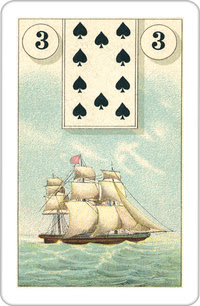
The Ship-3 card 
A small glitch if you will is that a couple of books are mentioned throughout the text, but there is no list of sources or consulted works listing them in one place. That could've been helpful. Overall though we get a good basic instruction book. 

 The cards feature a traditional art style evocative of classic paintings. The card art includes playing card associations. By now, I've collected a few Lenormand decks, mainly for the art but also for future use. I find that I tend to prefer Lenormand cards with the playing card associations. By the way, the book does not discuss the significance of the playing card associations. If this is of interest, you'll need to look for that information elsewhere. 

The cards measure about 4 inches by 2 1/2 inches. They are small but doing a full Grand Tableau spread will still take up some space. Given the basic classic art style the card imagery is clear. The cards are not labeled, but with clear art a reader should be able to identify the individual cards. Cards have a soft glossy coating, and they shuffle easily. The card back art is reversible if you are so inclined. 

In the end, if you are looking to start learning and studying Lenormand, as I am now, this kit is a good option. A topic here or there could use more depth, but overall the kit works to get you started in an easy way. The cards feature straightforward images that work well for Lenormand readers at any level. I'd still suggest this kit for anyone starting to learn Lenormand, more so if you can get it at a sale price as I did. 

4 out of 5 stars. 


This kit qualifies for the following 2025 Reading Challenge: 


Sunday, June 08, 2025

Reading about the reading life: June 8, 2025 edition

Welcome to another edition of "Reading about the reading life" here at The Itinerant Librarian. This is where I collect stories about reading and the reading life. Basically, these are items related to reading, maybe writing and literacy, that I find interesting and think my four readers might find interesting as well with a little commentary. As with other features I do on this blog, I do it when I have time or feel like it. Comments are always welcome (within reason).


Once more, I find that it has been a while since I have done one of these features; last time was back in 2024. Time can fly when you are just trying to stay alive in the Hard Times. Plus to be honest, I've been focusing a bit more here on writing good reviews and just doing some reading. Anyhow, here are a few items I've read that I thought were interesting and my four readers might appreciate. 

  •  Via ArabLit, a look at what people in Gaza read during a war. We find in this story that " just as the human spirit perseveres, so too do books, despite the horrors, destruction, and annihilation in Gaza." 
  • In Russia, a segment of the population reads what is known as "Z literature," which is defined as "a subgenre of Russian fantasy fiction characterised by nationalistic, pro-war storylines, has been on the rise since Russia’s full-scale invasion of Ukraine began three years ago and may be pushing young readers towards enlisting in combat." Story via The Guardian
  •  Via Arab News, a look at the growth of book cafes in Riyadh, Saudi Arabia.
  • Speaking of reading establishments, the last bookstore in Greenland recently closed. Via Nordisk Post.  
  • From El Diario (Spain), a look at the oldest library in the world, which was founded by a woman in Africa, and it is still running to this day. 
  • Via My Modern Met, a look at recent research that shows what happens in the brain when you are reading.  
  • Over at Counter Craft, they're looking at the selling of books along with the AI scandal about the fake book list and a bit more.  Article also looks a bit at what is left of professional book reviewing, as it was once done in reputable newspapers and magazines. According to the author, apparently people do not read book reviews any more. Well, I am not giving up. I write reviews mostly for myself to remember what I read, and maybe to share with my four readers; it's also my small bit for reader's advisory. If anyone after that finds them interesting, feel free to drop me a comment. Do you read book reviews? Mine or anyone else's? 

And that wraps it up for this week. As always, comments are welcome, and if you've read anything interesting about the reading life feel free to let me know. Have a great day. 


Friday, June 06, 2025

Signs the economy is bad: June 6, 2025 edition

Welcome to another edition of "Signs the Economy is Bad" here at The Itinerant Librarian. This is the semi-regular (as in when I have time and/or feel like doing it) feature where I scour the Internet in search of the oh so subtle hints that the economy is bad. Sure, pundits may say things are getting better, but what do they know? And to show not all is bad, once in a while we look at how good the uber rich have it.


My goodness. It has been a while since I wrote one of these, really, since 2023. What can I say? I've been busy with a few other things, reading and reviewing some good books, and just overall trying to stay alive in the Hard Times. Anyhow, I decided to keep an eye out this week for possible stories and see if I could get enough to make a post. The RSS feeds and social media did not disappoint. So let's have a look at some of the signs the economy is bad this week.


Education News


  • AI seems to be coming for more jobs as computer science majors, including all those people told to "learn to code," are finding lower employment options. Story via Futurism. Not only that, but if they manage to get hired, their odds of getting laid off or getting replaced by AI technology are also high. One of the reasons, according to a business consultant cited in the article: "Entry-level roles are vanishing, unpaid internships are still rampant, and companies are offshoring or automating the very jobs these grads trained for." So exploitation is the story of the day  pretty much. 
    • Adding salt to the wound, an "expert" states that artificial intelligence (AI) will bring massive job losses in the United States. Who is the expert? Anthropic CEO Dario Amodei. Now, a shit ton of people will be losing jobs within five years, according to his vision, but think of the positives. Amodei states: “'Cancer is cured, the economy grows at 10% a year, the budget is balanced — and 20% of people don’t have jobs,' said Amodei, describing one potential scenario." Hmm, curing cancer may sound pretty good; it also sounds like serious self-interested hype. 


Rural News 


  • The Kentucky Lantern reports that GOP cutting funds to food assistance would be seriously bad for rural America. Gee, imagine that. Why is that an issue for rural people? Well, for one, they "are more dependent on food stamps, the largest anti-hunger program in the nation."
  • And speaking of poor rural areas that may be affected by those funding cuts, Kentucky would be one of them. The state, according to a recent study, is in the top ten of poorest states in the U.S. Story via Fox56. You mean all those wonderful GOP supporters here who helped elect the Pendejo In Chief might have some economic issues as a result? Say it ain't so. 


Meanwhile back in the US colony 
(Puerto Rico news)


  • Via Periodico La Perla (PR, Spanish language news),monthly costs of food, housing, and transportation are going up for the general population. 
    • The story is based on MIDA's (The Chamber of Food Marketing, Industry and Distribution (MIDA by its acronym in Spanish) report on consumer report for 2025 (link to press release, Spanish language); they released a preview of the report, which is not due until middle of June 2025.  The study also reveals concerns over cuts to federal programs like SNAP (PAN by its Spanish acronym) and Medicare. 
    • For an English language account, the San Juan Daily Star also picked up the story
  • Meanwhile, the University of Puerto Rico publishes a research based profile of PAN (SNAP in English) recipients on the island. Story via the San Juan Daily Star. The profile of households "shows that most include an older adult, while half include a member with a disability." 


The Bad Economy Around the World


  • Across the pond in Great Britain, via the BBC an account of a working person who is homeless. The man works full time, and is "lucky" he sleeps on his mother's living room floor. As often happens, it does not help that rents are high and if you lack a credit score, landlords just outright refuse to rent. 
  • Meanwhile in Canada we get the story of a family who lived in a hotel for a year after losing their home. Story via CBC. Often, all it takes in a family is for one family member to lose a job, thus losing an income stream, and off to the streets they go. As I often say to my four readers, there but for the amusement of the Cosmic Joker go you and me. 


  •  Speaking of AI, this headline from The Walrus says it all: "Companies Are Outsourcing Job Interviews to AI. What Could Go Wrong?" The issue, well, for one: "Critics warn that hiring algorithms can be biased, opaque in their goals, or just plain junk, causing real harm to candidates and preventing qualified people from getting jobs." But corporate greed and making sure the stakeholders and investors get paid means cutting jobs and letting the bot do your hiring. Indeed, what could go wrong? 
  • In the U.S. where foreign tourists are not welcomed as the official rule, and they risk being deported to an El Salvadoran gulag, tourist destinations in the U.S. are finding that business is a little short. Things may be getting a little desperate as these tourism operators are giving a variety of discounts to entice travelers, especially Canadian travelers. Story via CBC. Maybe the Pendejo In Chief saying he wants to annex Canada is not a good idea. Just saying. 


Uber Rich


  • Apparently some of the uber rich are having some cash flow issues as they are not purchasing as many second home and/or vacation homes as they used to buy. Story via Axios. This observation is based on mortgages data that found there are less mortgages being written for second and/or vacation homes. Apparently in the Hard Times "even wealthy cash buyers are watching their wallets." 
  • The United States has recently acquired a reputation of not welcoming immigrants anymore. That is far from the truth as there is at least one type of immigrant that is welcomed with open arms: the wealthy immigrant willing and able to spend some serious money to get a golden visa.  Story via NPR. For $5 million dollars you can get in the express lane to enter the United States. For that price you can get the gold card, which is "a glorified green card that would allow them to live and work in the U.S. without going through the usual hassle or red tape. Apparently, the card's $5 million price tag is not scaring off the jet-setters looking to make the U.S. home. Or at least one of their homes." We all know the uber rich are special and so they should not suffer the indignities of having to apply for a green card or visa like the rest of the peons. So if you got the money, America says, "come on over, we got a place for you." 
  • Overall, the United States is not doing as bad as some naysayers say. After all, according to a new report, the U.S. had a massive rise in the number of millionaires in the nation.  Story via Quartz
    • If you are curious, here is the Capgemini report the story is based on (link to press release, which includes link to the report's download). 
    • Meanwhile, regarding the hoi polloi "according to the latest Census Bureau data, nearly 37 million people in the U.S. were living in poverty in 2023."